

Sajitha Madathil’s book tells the long‑ignored story of the women who shaped Malayalam theatre, bringing their lives and work out of the shadows and into view.
Histories are always his-stories, as they say. Finding the her in the written histories is not an easy task. Mainly because histories are always written by the Him-s. Hardly by the Her-s.
The same story repeats in all written histories, including that of theatre. Women are always present through their absence. And when it comes to the history of theatre in Kerala, or the Malayalam theatre, if you choose to go by the language, again you can find a gaping absence of women in almost all the written or documented histories especially from the early years of its evolution.
As in most of Indian traditions, theatre also lacked a process of documentation especially in the pre-digital era, which led to the histories written at a later stage to depend oral documentation of memories. As most of these historians were men, naturally it was always the story of men who wrote plays, directed, produced and acted. Women were present only as actresses, and they always remained unnamed, undocumented.
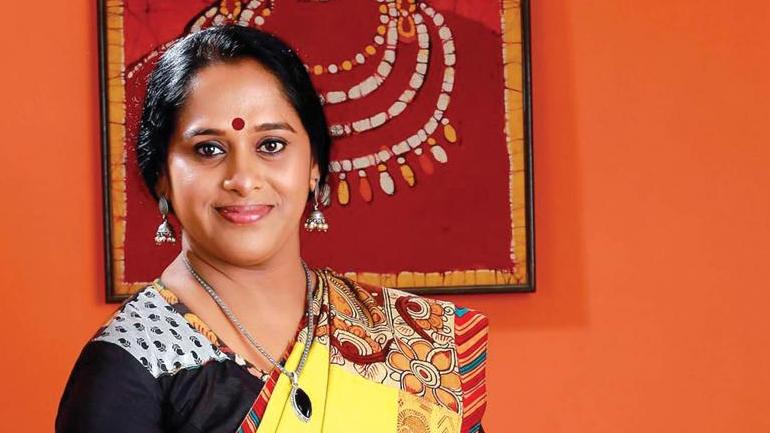
It is into this vacuum of information that Sajitha Madathil, who has been actively involved in Kerala’s theatre scenario for more than three decades in the capacities of a playwright, director, actor, activist and researcher, steps in. For decades, Sajitha meticulously searched within the world of women who had played an active role in shaping the almost 12-decade long history of Kerala’s modern theatre. When her seminal work in Malayalam, ‘Malayala Nataka Sthree Charithram,’ was published, it threw valuable light on a hitherto obfuscated portion of Kerala’s theatre history.
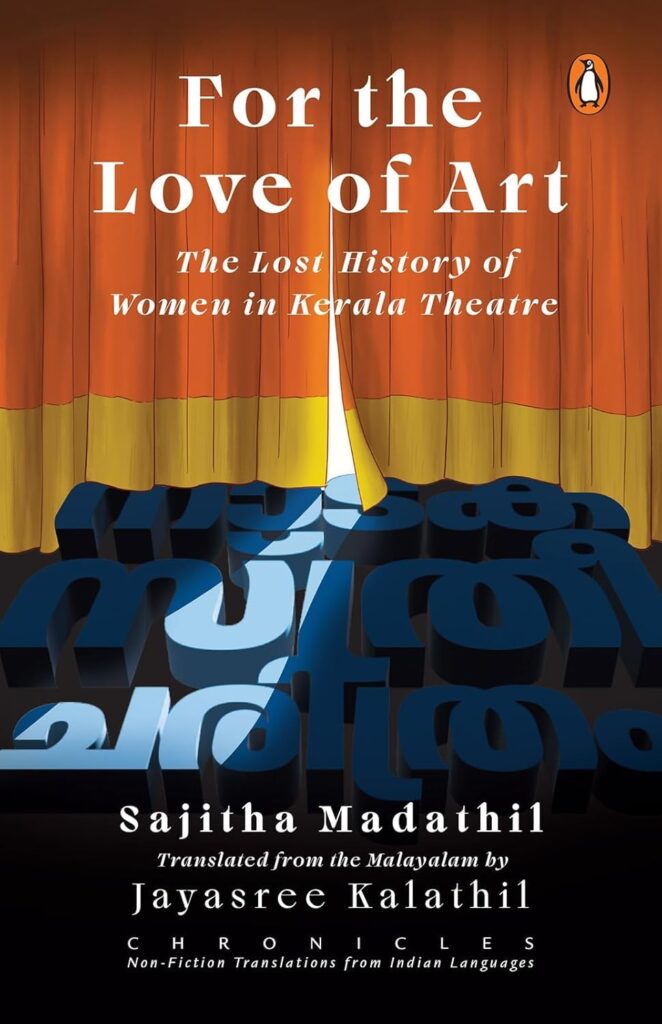
‘For the Love of Art: The Lost History of Women in Kerala Theatre,’ the English translation of Sajitha’s ‘Malayala Sthree Nataka Charithram,’ translated by Jayashree Kalathi, and published by Penguin Random House, helps to bring that hitherto untold history to a wider audience outside the world of Malayalam readers.
Theatre, politics, and feminist assertion
Unfolding gently like a story, ‘For the Love of Art: The Lost History of Women in Kerala Theatre,’ leads the readers through the social milieu of the late 19th century and early 20th century Kerala when the Malayalam theatre scenario was emerging. And I like it when history is being unfolded gently, like a story.
Because I think that is also a woman’s way of seeing. Rather than lining up columns of statistics and data, Sajitha Madathil chooses to narrate this story through the stories of women who were themselves the protagonists. She moves through the historical narratives from the time when Kutti Kunju Thankachi and Thottakkattu Ikkavamma broke into the field of theatre as playwrights, to the stories of P.K. Rosy and Palluruthy Lakshmi, the tragic early heroines of Malayalam stage.
Divided into eight chapters , ‘Out of the Shadows, Gently: Women and the Birth of Theatre in Kerala,’ ‘Rivalling Real Women: Female Impersonation in Tamil and Malayalam Musical Dramas’,’ ‘Into the Limelight: Early Heroines of Musical and Social Theatres,’ ‘Making a New Malayali Woman: Women’s Agenda in the Theatre,’ ‘On the Political Stage: Women in the Leftist Revolutionary Theatre,’ ‘A Balancing Act: The Theatre as Workplace,’ ‘Into the World of Contemporary Malayalam Theatre,’ ‘On Her Own: The Emergence of Women’s Theatre’ Sajitha’s book combines the history of women in Malayalam theatre to the socio-political history of Kerala, carefully delineating the lives of women associated with the Leftist cultural movements as well.
She also presents detailed analyses of the portrayal of women in the plays that emerged during the socially and politically transformative era of Kerala, including Thoppil Bhasi’s ‘Ningalenne Communistakki,’ Cherukadu’s ‘Nammalonnu’ and K.Damodaran’s ‘Pattabakki.’
Sajitha Madathil delineates the emergence of a Feminist theatre in the contemporary Malayalam stage from the 1990s, in which she had also played a large role. She has also highlighted the challenges faced by women in contemporary Kerala in choosing theatre as a profession and livelihood.
Like all histories, ‘For the Love of Art: The Lost History of Women in Kerala Theatre,’ need a second volume, continuing the documentation of the history of women in more recent times. Hopefully, Sajitha will be able to take up that challenge soon! And hopefully, this volume will also encourage more studies on the women in Malayalam theatre, from different angles and perspectives as well.



1 Comment
A rather comprehensive review. One gets a bird’s eye view of what is dealt with in the book. The facile pen of Renu sketches the theme of the book in a readable manner, throwing light on the reasons for not documenting the role women played in theatre, an effective tool in dismantling old society and creating a new egalitarian one in its place. Kudos Renu , Sajitha and Jayanthi. Since writing History is a continuous and dynamic process , more volumes are expected.