

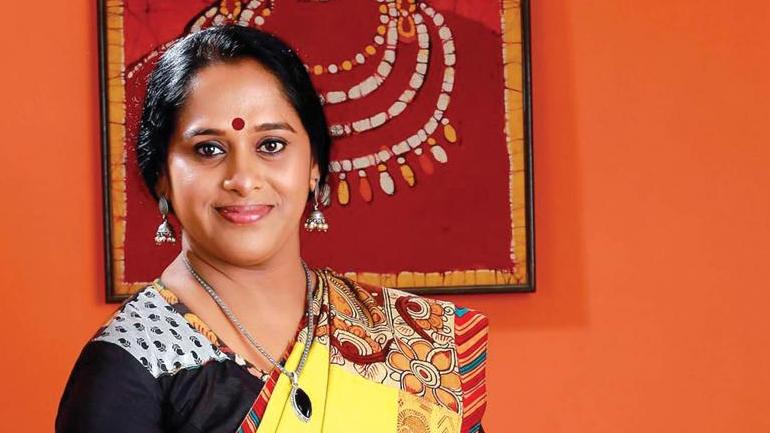
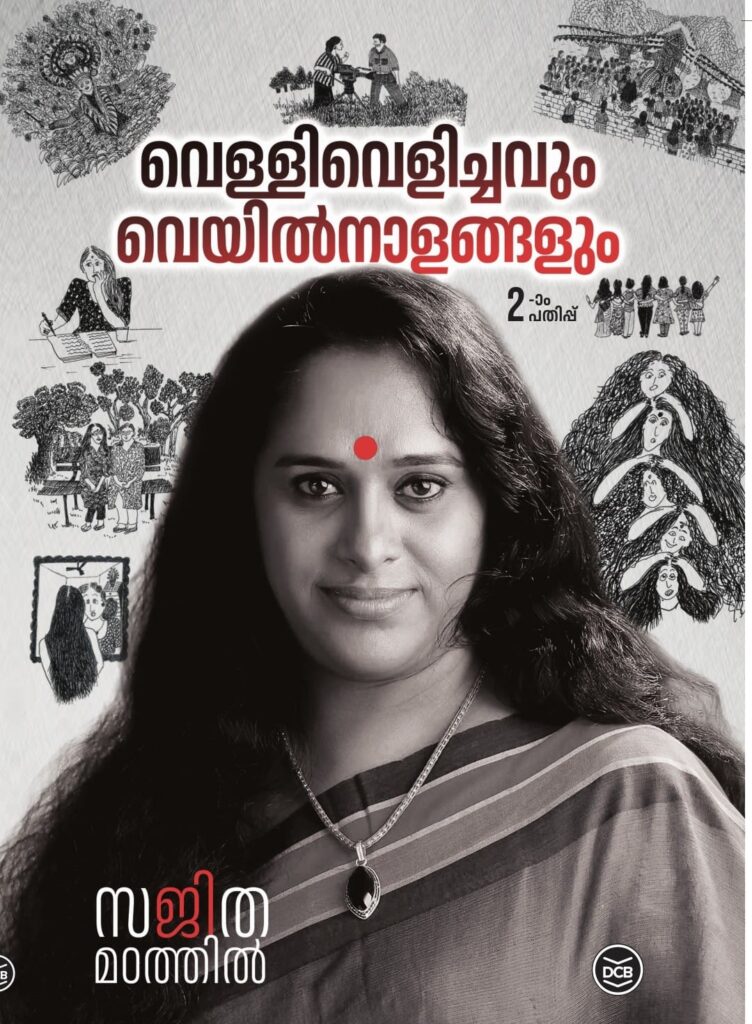
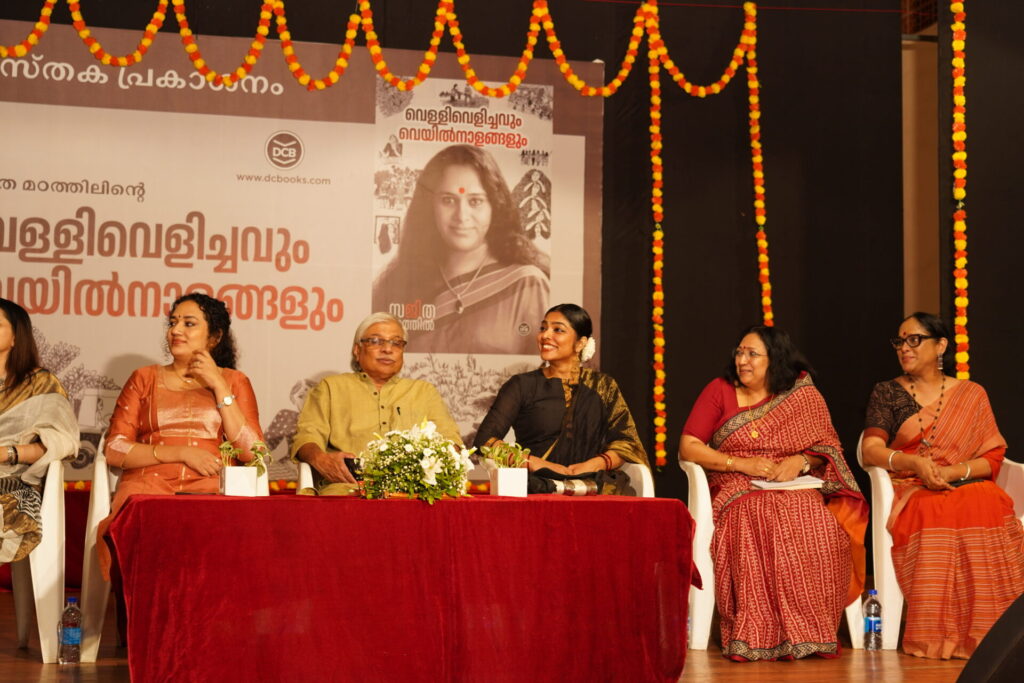
Dr. Sajitha Madathil’s memoir Vellivelichavum Veyilnalangalum retraces a journey through grief, activism, and art.
To write about one’s own life—especially a life shaped by hardship, struggle, art, and relentless questioning—is never an easy undertaking. Many artists shy away from it, fearing either self-indulgence or exposure. Dr. Sajitha Madathil, however, embraces the challenge with courage in her autobiographical work Vellivelichavum Veyilnalangalum (Silverlights and Sunrays. An activist turned artiste, Sajitha not only tells her story but does so with a rare combination of vulnerability, humour, and unflinching honesty.
What immediately sets the book apart is its refusal to follow a straightforward, linear structure. Sajitha Madathil does not begin with her childhood and proceed neatly to the present. Instead, she opens with a raw, formative memory—the death of her father when she was only three. From this point, memory and reflection intermingle, shifting between moments of sorrow, flashes of discovery, and decisive turning points in her artistic journey.
Her early years in her mother’s ancestral home in Calicut were steeped in the atmosphere of a joint family, with its feudal undertones and cultural peculiarities. It was here, within the seeming confinement of tradition, that Sajitha first found her release through art. At the age of ten, she performed a Rangapooja at her school anniversary function. What might have been an ordinary event for another child became, for her, the revelation of an inner calling. Kalamandalam Chandrika, recognising the spark, invited her to join her ballet troupe. As a child artiste, Sajitha travelled widely with the troupe, performing across Kerala.
Kolkata, Delhi, and beyond
For Sajitha Madathil, art was never separate from life. During her student years at Government Arts College, Meenchanda, her social consciousness deepened. She became a committed activist, participating in progressive movements and women’s empowerment campaigns, even as her artistic practice shifted from dance to theatre. Her first leading role in Muditheyyam—a play based on Sara Joseph’s writing and directed by K. S. Sreenath—was met with such encouragement that she resolved to dedicate herself to theatre. This decision led her to Rabindra Bharati University in Kolkata, where she trained under stalwarts like Manoj Mitra, Bibas Chakraborty, Kanishka Sen, and Jogesh Dutta. Kolkata exposed her to the intellectual rigour and cosmopolitan openness of modern Indian theatre.
After completing her post-graduation, Sajitha moved to Delhi, where she secured a junior research fellowship under the Central Cultural Ministry. Life during this period was a delicate balancing act: she became a mother to her son Aromal, while simultaneously pursuing challenging roles. A landmark in her career was Beauty Parlour, a solo performance directed by Sreenath, which won wide appreciation and confirmed her as a serious theatre practitioner.
In 2002, while working with Kairali TV as a programme producer, Sajitha was invited to South Africa to perform in Matsyagandhi. The production became a milestone, not only for the exposure it brought but also for the people it introduced her to. Among them was John Martin, the renowned theatre director, whose humility and respect for actors left a deep impression on her. In her book, she contrasts his calm, ego-free approach with the authoritarian style of many directors she had encountered in Kerala.
Art as resistance
On her return to Kerala, she performed in Pralayam (directed by Samkutty Pattamkari), Spinal Code (by Deepan Sivaraman), and Mathilukal (by Pramod Payyannur). At the same time, she shouldered demanding responsibilities as Deputy Director at the Kerala State Chalachitra Academy. She continued to write and perform plays. Among these, Kali Nadakam emerged as a groundbreaking work.
Directed by Chandradasan and produced by Lokadharmi, the play sparked widespread debate for its bold political message and innovative presentation. Though inspired by an idea from her childhood, Sajitha approached the production with rigorous preparation and practice. Chandradasan’s supportive, egoless approach and his insistence on gender equality gave her the freedom to inhabit the role fully. For Sajitha, Kali Nadakam reaffirmed that theatre could still serve as a space of resistance and questioning in contemporary society.
During her tenure as Deputy Secretary at the Sangeet Natak Akademi, Delhi, Sajitha video-documented diverse folk-art forms of India, often travelling with the artistes themselves. This work not only deepened her knowledge but also cemented her confidence in collaborating with artistic communities across the country. Her meticulousness and uncompromising passion for art were evident in this phase, which opened new avenues for her engagement with cultural documentation.
Her foray into cinema came relatively late, with Joy Mathew’s Shutter, followed by several other films and short films by eminent directors. Yet even here, Sajitha’s relationship to cinema was shaped less by glamour than by activism. In the book, she insists that her involvement in film societies was rooted in her role as an activist rather than as an actress, underlining her conviction that art must remain inseparable from social engagement.
What makes Vellivelichavum Veyilnalangalum especially compelling is its portrait of the wider world that shaped Sajitha’s life. Beyond recounting her personal struggles and artistic milestones, she vividly reconstructs the socio-economic and cultural landscapes of Kerala over the last fifty years—the feudal remnants of the joint family system, the constraints on women’s freedom, the political ferment of student activism, and the possibilities of creativity that could emerge even from adversity. Her reflections are not self-glorifying but deeply rooted in context, making the book valuable both as memoir and as social history.
Sajitha Madathil does not shy away from describing her moments of despair, setbacks, or conflicts. Yet the lasting impression is one of courage—the courage to challenge conventions, to confront authority, and to persist in the face of tragedy. Equally moving is her acknowledgement of those who stood by her: her mother, who provided strength, and her sister Sabitha, who remained her steadfast companion.
Written in a style that is unpretentious and direct, the memoir draws readers in with its simplicity. There are no flourishes or elaborate literary devices, but the sincerity of the voice leaves a lasting impact.
Publisher : DC BOOKS
Number of pages : 224
Price : 299