
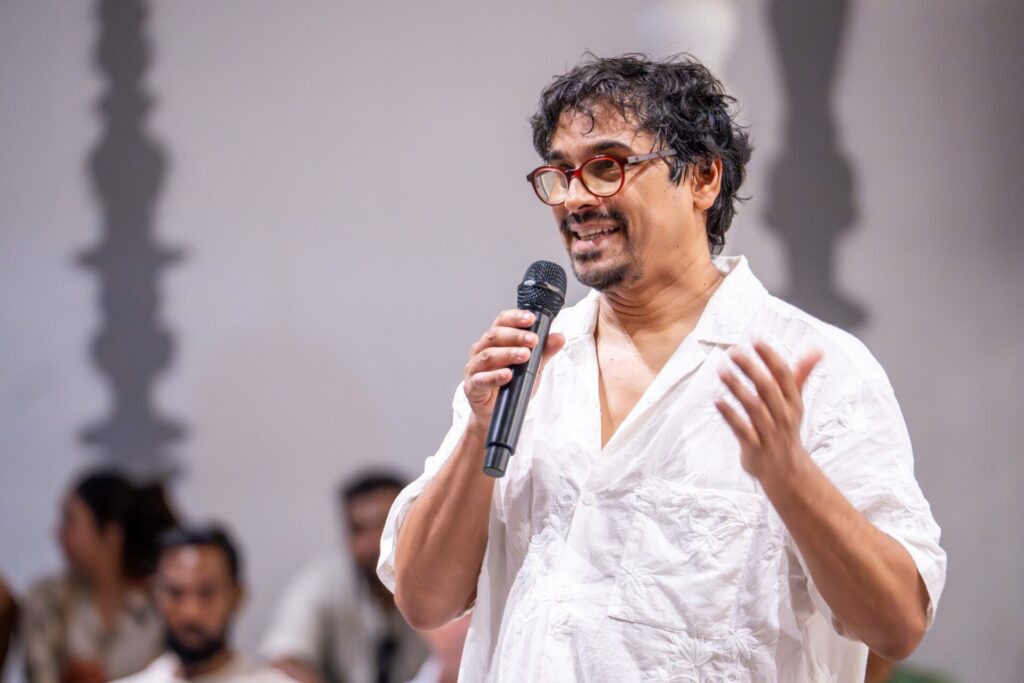
Raphael Bianco, born in Mumbai, is a trained dancer and choreographer with expertise in classical and contemporary dance. He completed his studies in choreographic composition and Laban theory under Susanna Egri and Karin Waehner. He currently dances with Ballet du Nord, the National Choreographic Centre of Roubaix, France. He co-founded Compagnia EgriBiancoDanza with Susanna Egri in 1999. At the Kochi-Muziris Biennale, he performed ‘Leonardo da Vinci: Anatomie Spirituali,’ the second of three performances in the series.
In ‘Leonardo Da Vinci: Anatomie Spirituali,’ Raphael Bianco tries to explore the curiosity of Da Vinci in his sketches connecting human body to the spiritual realm. Da Vinci’s anatomical sketches documented bones, muscles, tendons and also the spiritual network. They also delve into deep philosophical enquiries into human existence. This duality inspires Bianco to investigate the invisible energy that influences human behaviour and consciousness.
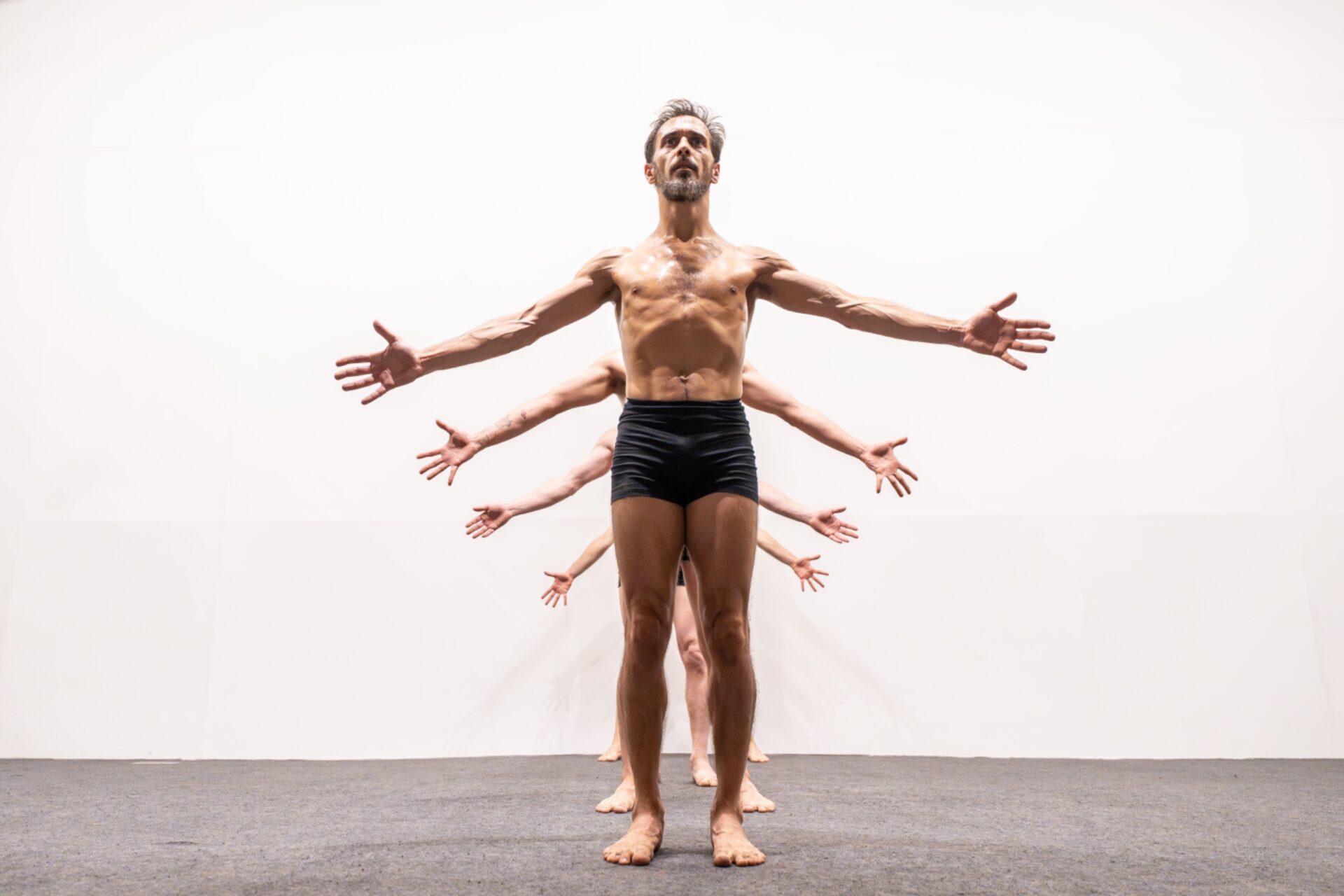
Rather than trying to replicate Da Vinci’s sketches, Bianco approaches them conceptually. Bianco’s choreography includes a lot of pauses and rhythmic sequences. The dancers’ bodies become reflection on Renaissance ideals of movement and anatomical research. Stillness and silence becomes the language of the performers.
Grace in every turn
Four dancers performed the piece, incorporating sudden pauses, independent movements and coordinated group sequences. The dancers highlight the different frameworks that constitute the human body through rhythmic and heavy breathing techniques. When stretched into unusual poses, parts of the body highlight the tension of muscles and tendons.
The performance slowly transforms into a choreographic wonder as the dancers begin to move with an almost divine grace. Smooth and flowing movements that pass from one dancer to another create a striking visual impact. Even the smallest movements become deeply spiritual as the performance progresses.
The performance lasted about half an hour. Bianco took the stage receiving a standing ovation. Bianco then explained the dynamics of the dance and congratulated his dancers for performing well.
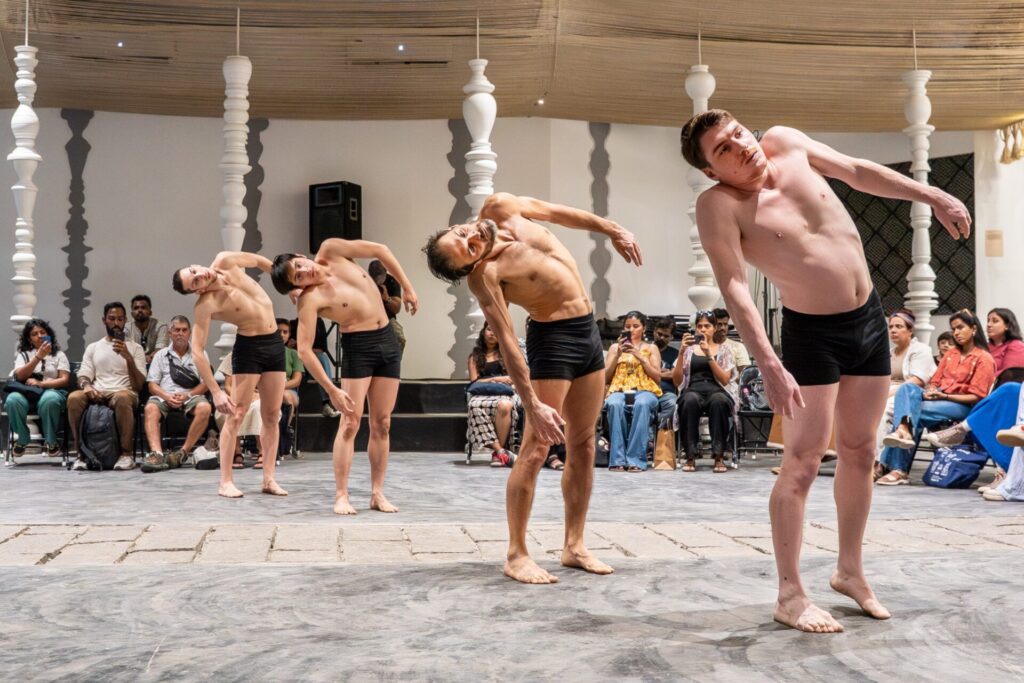
Anatomie Spirituali does not seek to tell a linear story. Instead, Bianco invites audiences to experience the work intuitively. Meaning emerges through sensation rather than explanation; viewers are encouraged to observe the dancers’ bodies and respond to the emotions and energies they convey.
For Bianco, the process begins with research. “When I first I have an idea I try to figure out how this idea can be embodied by my dancers. So I give them some tasks, specific tasks on how they could research about that idea, giving some limits on their improvisation so that the crux isn’t lost. So, in this manner, they try to find some solutions about the idea, about my task and then I collect all the vocabulary and this becomes the base of our choreography,” says Bianco. “Through structured improvisation the dancers generate a shared vocabulary of movement that eventually forms the core of the choreography.”
Exploring soul and human body
The performance explores themes such as the relationship between body and soul, human behaviour, prophecy and apocalypse. Bianco is able to translate these ideas into codified dance practice in his own independent style. “During the performance you could see that there was a person falling down, for instance, or screaming. These are few things that are really visible, that are talking about something that is destroying or you have fear,” says Bianco.
Space also plays a major role in Bianco’s choreography. Performers make full use of the space allotted to them unafraid to get close to the audience. Movement and emotions are created not only through body but also through spatial actions—running and jumping in unpredictable patterns, circling and converging moments. Choreography therefore become a dialogue between body, space and movement.
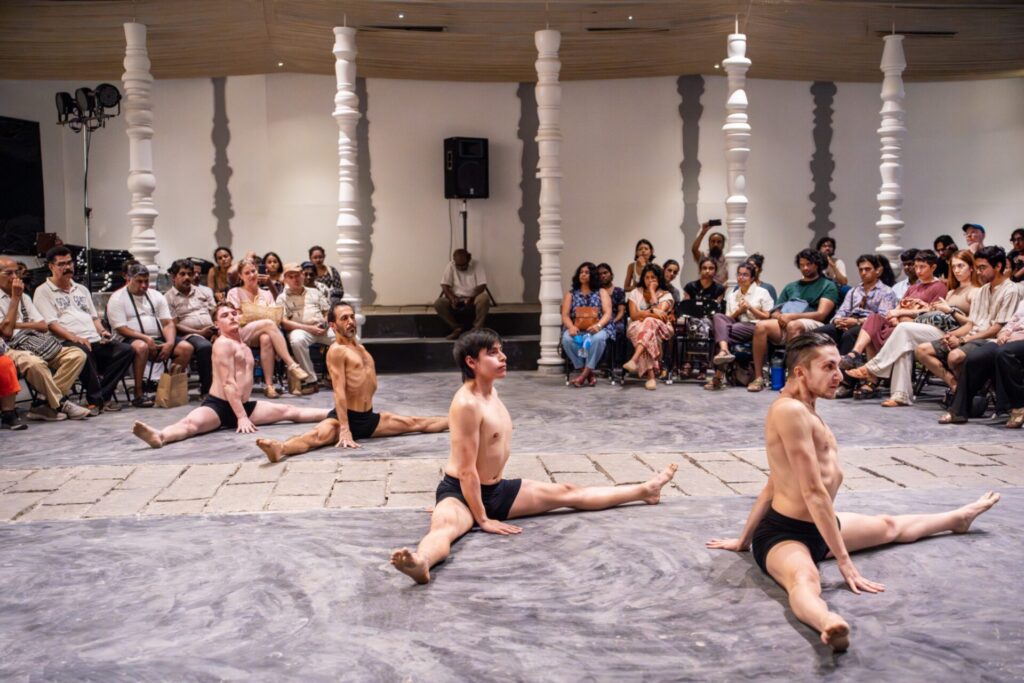
Anatomie Spirituali also does not try to tell a story or convey a message. Bianco invites audience to experience the work intuitively. “You do not have to understand it but try to feel the emotions it provokes,” says Bianco. “It is a question of looking at the bodies of the dancers and try to feel what they are giving to you.”
By bridging Renaissance enquiry with human body, Bianco suggests that human body in itself is a site of discovery. Just as Da Vinci studied anatomy to understand life, Anatomie Spirituali studies movement to uncover the same mystery.