

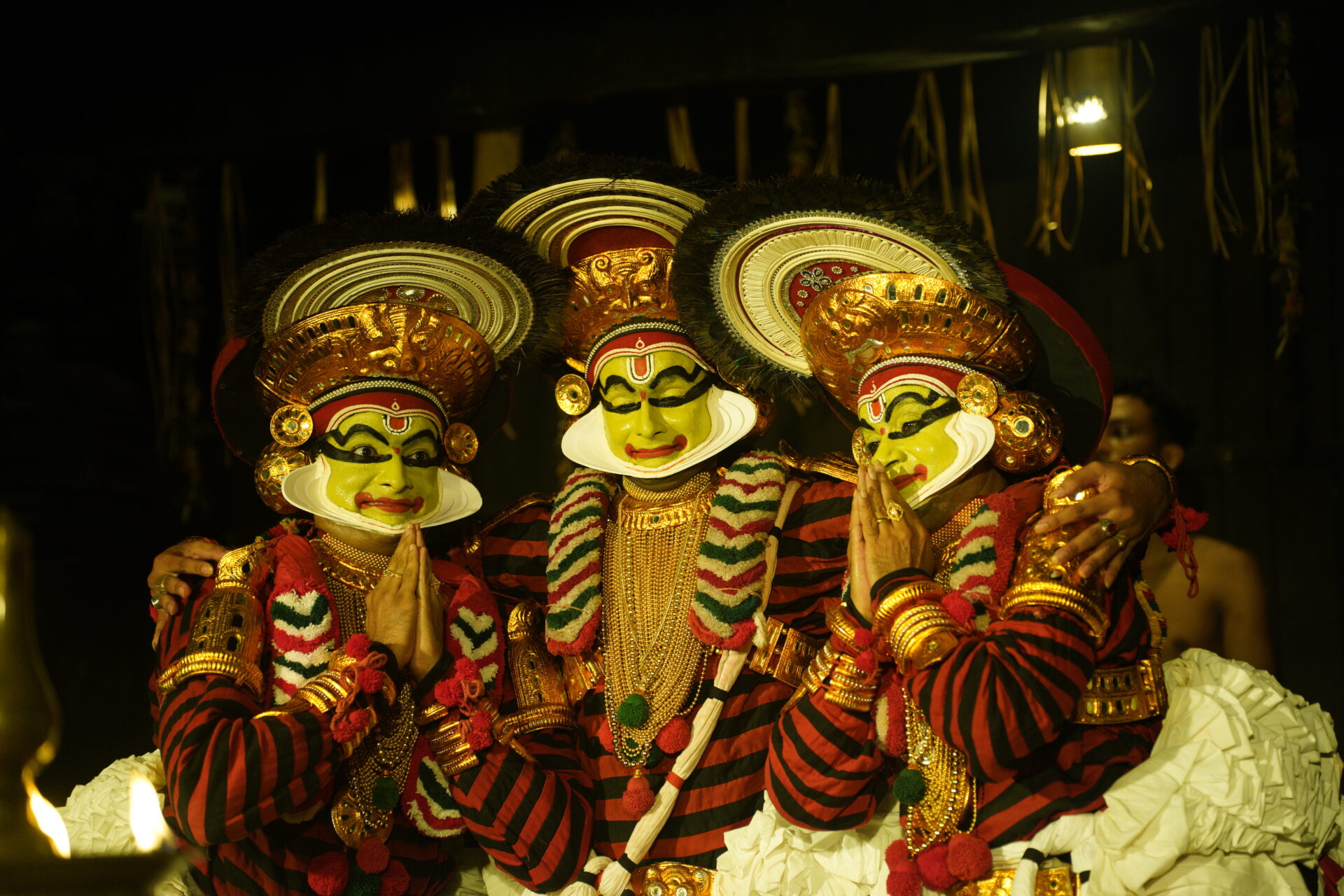
From wine-soaked parody to forest sorrow, Nepathya breathes life into two eternal Sanskrit classics.
A drunk skull-bearing Kapalika, Satyasoma, a follower of Lord Siva in his wildest, weirdest form, has lost his begging bowl, the priceless kapala. It’s his only possession. Together with his girlfriend, Devasoma, he searches for the lost bowl in the lively streets of Kanchipuram (1500 years ago). No luck. A rather smug Buddhist monk, well dressed, well fed, leading a comfortable life in the monastery, turns up with his own begging bowl.
The monk is grateful to the Buddha for providing him with such a cushy style of life, and he is sure that the Buddha also wanted the monks to enjoy wine and women; only because of the jealousy of the elders who run the monastery did this original provision get erased from the canon.
The Kapalika thinks the monk must have stolen his bowl. A wide-ranging philosophical dispute develops; Satyasoma mocks the Buddhist cosmos in which mountains, rivers, and all other objects do not truly exist. The monk produces from within his uniform a wide, round and elegant bowl, the very opposite of the Kapalika’s, which was once a human skull. Still, Satyasoma is certain that the monk’s bowl must be his, somewhat modified in color and shape.
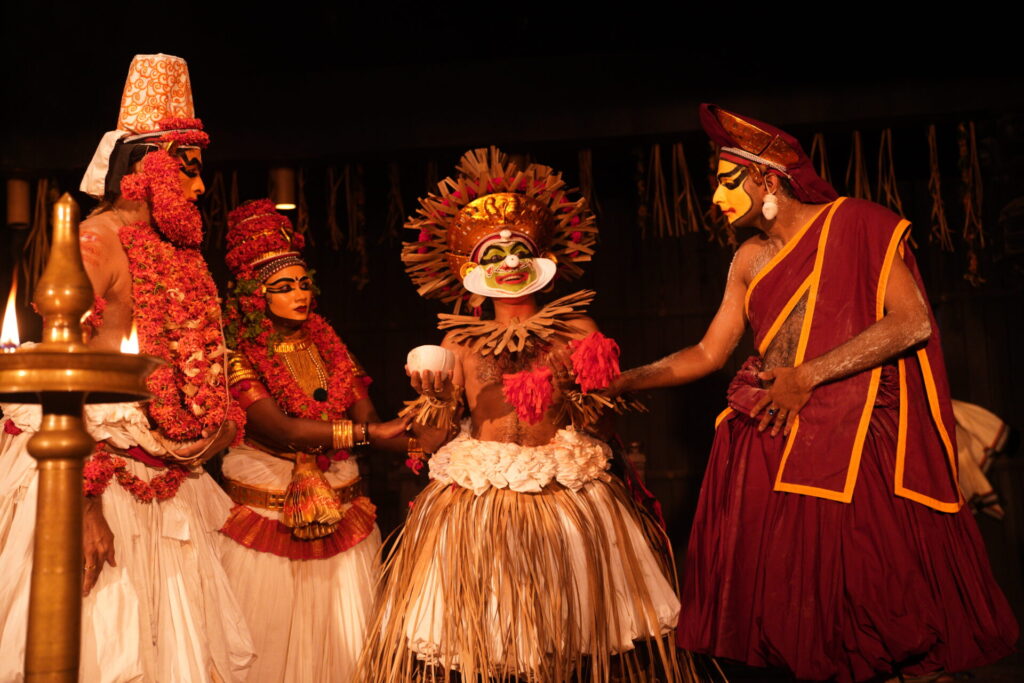
Eventually a Pasupata ascetic, far more moderate in worshiping Siva, tries to arbitrate, to no effect. A lunatic arrives, overflowing with words and fantasies, and quite capable of speaking the truth, as madmen sometimes do; he has the lost bowl (rescued from a dog), the Kapalika and the monk together pry it out of his hands, and all animosity dissipates in a joyful celebration of how what was lost has now been found.
This is the story of the Mattavilasam, “The Play of the Drunkard,” composed by the Pallava king Mahendravarman in the seventh century and performed in August of this year by the Nepathya Kutiyattam troupe in Muzhikkulam, headed by Margi Madhu Chakyar. There’s an important twist to this statement.
Return of Mattavilasam
For the last thousand years or so, the Mattavilasam was performed in Kutiyattam in a radically truncated version: only the first two verses were enacted, and the performance was primarily a three-day ritual—the shortest of all Kutiyattam plays—aimed at producing for the patron who initiated it a male child. (When I first saw it some years ago in Killimangalam, three of our female Sanskrit students who were with us did indeed conceive and give birth to boys within that year.) No one knows why the witty and sparkling Sanskrit text of the play was set aside.
In a bold move, Margi Madhu has composed an actor’s manual, the Attaprakaram, for the whole text, thereby reviving this delightful play for the benefit of today’s audiences. As usual, the gap between the printed text and the performance text is very wide.
The introductory section that survived in Kutiyattam, including some thirty verses from Kalidasa’s Kumara-sambhavam (chapter 3), was enacted in relation to the Kutiyattam frame-story: Satyasoma, the lead role, has unintentionally killed a Brahmin boy and been ordered by the Brahmin sabha to expiate his sin for twelve years by living out the Kapalika vow, imitating Lord Siva himself. That is how we find him as the plot unfolds.
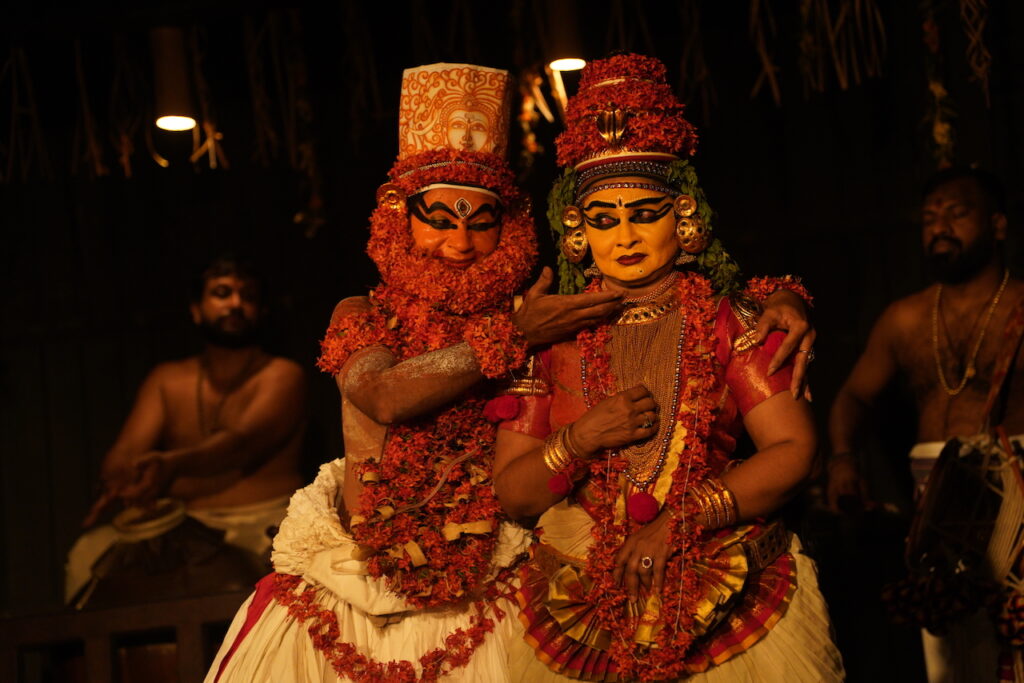
Actually, we see how this personal, embodied form of the god is created on stage, from head to foot. A moving moment takes place when the Kapali, now fully present in his role, exits the kuttambalam performance space in order to stand before a stone image of Nataraja Siva in the courtyard.
Oil lamps surround both of them; the eloquent drummers are quiet; the audience, sensing the richness of this interlude, have left the kuttambalam and gathered round. These two versions of the god, Siva the dancer and the Skull-bearing Kapali, stare at one another in hushed silence, each perhaps seeing himself reflected in the other. Then the play resumes.
It is an overtly parodic, antinomian performance, no holds barred—an anti-ascetic text in praise of the joys of sensual life in the world. We see a Rabelaisian playfulness with the possibilities that come with a human body and with the constant, underlying, creative power of desire. By the time the Madman arrives on stage, we are primed for a happy resolution of the Kapalika’s crisis, also for a bit of slapstick comedy.
At the same time, we begin to understand the Sanskrit verse that we heard at the opening of the performance, a hymn to the dance and the dancers that recurs at every turning point: Lord Siva is the dance, the dancer-actor, and the spectator, all in one. We, as spectators, have found our place inside the mind of the god and his games.
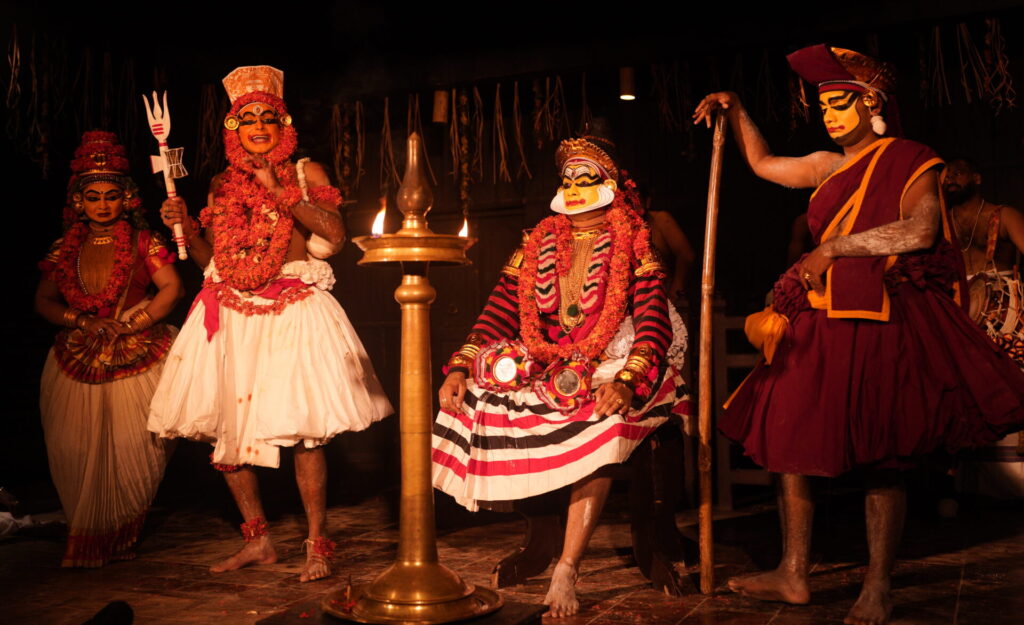
After five nights of this full version of the Mattavilasam, preceded by an evening of Nangyar kuttu (“Gandhari”) by Dr. Indu G, we were given a second incomparable gift: three nights of the Ataviyankam, “The Forest Act,” from the Pratimanatakam (“The Play of Images) attributed, probably wrongly, to Bhasa.
Bharata’s trial of love and loyalty
Pratimanatakam, one of the finest plays in the Sanskrit library, is a highly unconventional Ramayana work, now largely forgotten. It was once a standard part of the Kutiyattam repertoire, as we know from historical sources, but somehow it disappeared from live performance some two to three centuries ago. Once again Margi Madhu has taken a visionary step by reviving the first, third, and now fourth act of this play, in accordance with the extremely laconic instructions of the ancient stage-manual, the Kramadipika.
In Act III, Bharata, summoned back to Ayodhya, discovers that his father Dasaratha has died. His grief is overwhelming. He also discovers that Dasaratha died of sorrow because of his wife Kaikeyi’s demands that Rama be exiled for 14 years and Bharata be crowned king in his place. Bharata wants no part in this dark maternal plan. In Act IV he seeks out his brothers, Rama and Laksmana, together with Sita, in the forest.
Bharata begs to be allowed to stay there with them for all 14 years, but Rama refuses to accept this; Bharata must rule in Ayodhya until Rama returns. The brothers, now reunited in a transient moment of intense pathos, affirm their love for one another before parting again, for many years.
In my experience as a spectator, the main thrust of the play has to do with Bharata’s shifting, maturing character. At first, as he arrives in the forest, he is burdened with guilt as the apparent beneficiary of Kaikeyi’s nefarious plot. He is also self-pitying and self-absorbed. In the relatively short but volatile dialogue with Rama, who threatens to curse Bharata if he won’t return to rule the city, Bharata has to make a split-second decision. He rises to the occasion: he will do as Rama tells him, while keeping Rama’s sandals on the throne as a sign of the true king.
One might say that Bharata grows, with astonishing rapidity, into his true self, becoming a full-blooded person in his own right, in the course of this short act. He knows what he has to do, knows he can’t escape. The anonymous author of the Play of Images had a profound sense of what comprises a living human self and how, slowly or suddenly, such a self can emerge and survive.
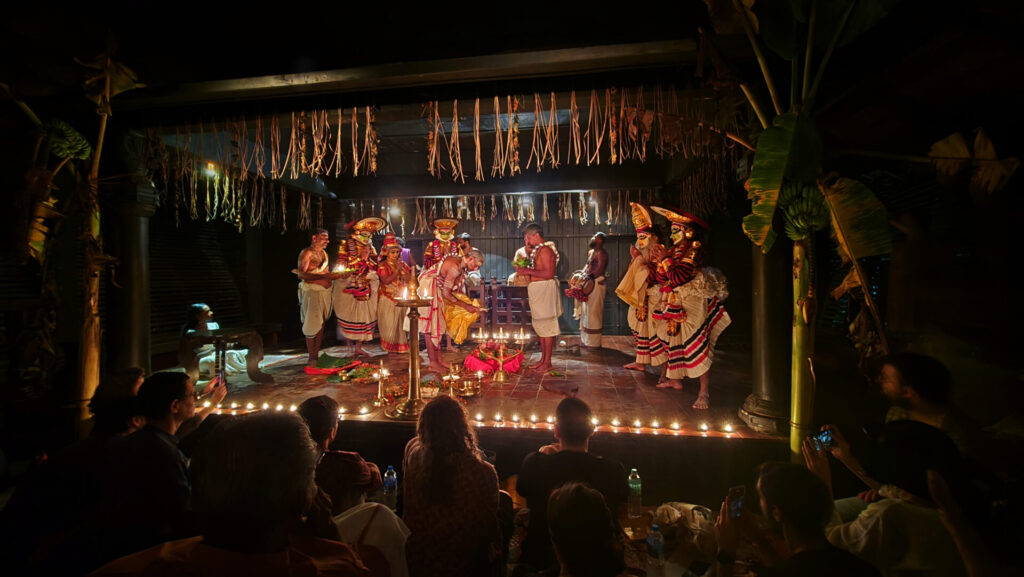
Before Bharata leaves, we see on stage the kalasam ritual offered to Rama’s sandals—performed by a Tantri priest who was also once a Kathakali actor, like his father. The ritual, in many sequential stages, was compelling beyond words—the stage alight with dozens of oil lamps as the priest slowly created a divine emergence by his stylized gestures and precise acts of worship.
This was wonder, adbhuta, ascarya, vismaya, in a setting that only Kutiyattam could create. God exists. Everyone—Rama, Laksmana, Sita, Bharata, the Tantri and his assistant, the mizhavu drummers, the Nangiyar who marks time with the cymbals and recites the verses, in short an entire world—is there on the stage as the kalasam is meticulously created and given in blessing to those perfect sandals.
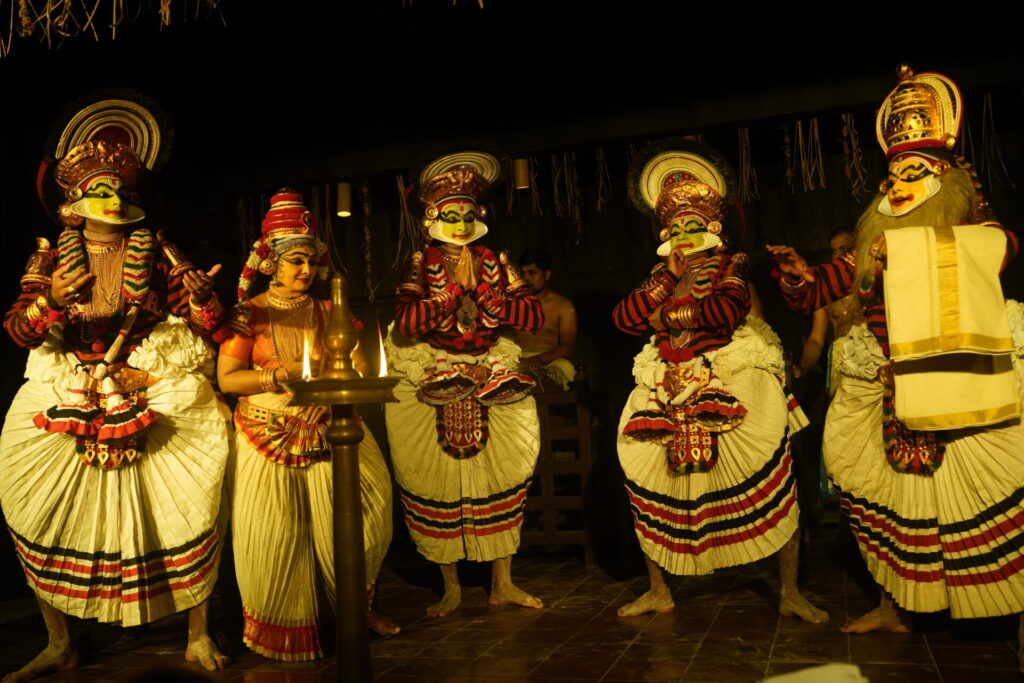
The key to understanding this ancient art lies in seeing a complete, full-length play, usually spread over many hours and many nights (30 hours, 60 hours, 100 hours, forty-three nights). The performance has a temporal mode of its own and a unique cosmos that it creates before our eyes and then takes apart on the last night. The slow cumulation of feeling and cognition as the play deepens, night by night, ends in a finale of unthinkable aesthetic power.
For me and my colleagues and especially our students, who have been coming to Muzhikkulam every year for the last 17 years, each complete Kutiyattam performance is a life-changing event. A night without three or four or seven hours of Kutiyattam no longer counts as a night.
Photos: Achuthan T K, Adarsh A S

1 Comment
Excellent description of an incredible 9 nights. Thanks David for capturing it in words. Feel blessed to have been able to participate as a member of the audience.