
On World Music Day, Jerry Amaldev conducted a three-hour choral journey that wove Mozart, Negro spirituals and his own Malayalam film classics into a single, unifying harmony.
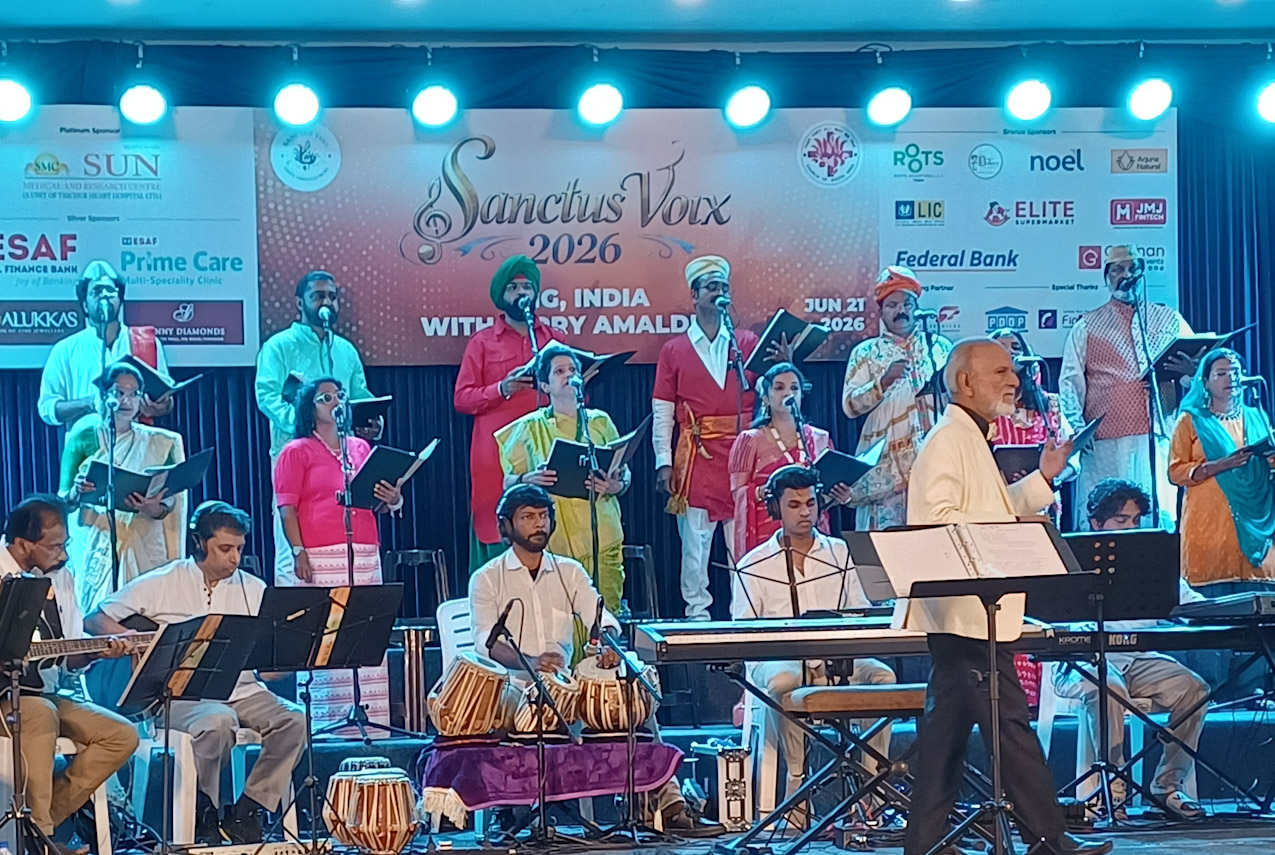
It was sublime music that flowed for three hours at All Saints’ CSI Church, Thrissur, on World Music Day 2026 (June 21). The rendition by “Sing, India with Jerry Amaldev” (SIwJA), the choral wing of the ‘Jerry Amaldev Foundation ’, was an ingenious mix of the four-part harmony of the Western Classical music tradition and Indian music noted for its alluring melody.
The team of 12 vocalists (six males and six females), all attired in the traditional costumes of different states of the country, was a paradigm of India’s unity in diversity. They were supported by eight instrumentalists as well. Interestingly, of the 24 numbers presented, many were immortal contributions of Jerry Amaldev to the Malayalam films.
Apart from these, a classical composition of Mozart, a Negro Spiritual, two Latin compositions and Jerry’s own religious songs covered a wide spectrum of the universal musical traditions.
From Mozart to Malayalam: An unlikely harmony
The programme opened with Thejassitha, Jerry’s own composition to the lyrics of Fr. Cheriyan Kunian Thodathth of Chennai Orthodox Church. An energising hymn which means “Here comes the Divine Light” that brings out the cosmic image of the divinity, Jesus Christ, as the Universal Saviour. The peculiar rhythm of the composition 5/8 in the Indian context represents Tandava, the cosmic dance of Lord Shiva.

The next was the Latin composition of the maestro Wolfgang Amadeus Mozart, really an intricate one for any choir. He had composed it a few weeks before his death, and it entails the essence of his faith. But trained as they were for years, the choir gave it out impressively.
Jerry’s own four compositions, Manjadikunnil, Pookkal Panineer Pookkal, Mizhiyoram and Kanninnu Ponkani, followed.
Jerry Amaldev introduced another Latin composition Panis Angelicus written by St. Thomas Aquinas. A part of the main composition, this means “bread of angels” that has been set to music separately from the main one “Sacris solemnities. In 1872 Cesar Franck had set this strophe (a section) for tenor voice, harp, cello and organ.
Before a short break, six more of Jerry’s alluring compositions were rendered, including Aalorungi Arangorungi, Kiliye Kiliye, Nirmalamayoru Hrudayamennil, Mounangalae Chanjaduvan, Akkuthikkuthaana Varambathu and Vachaalam.
The second part, after the break, was especially noteworthy for Vande Matharam sung by Rabindranath Tagore at the Indian National Congress session in 1896, which was later adopted as the National Song. Interestingly, Jerry stumbled upon a gramophone record in Madhya Pradesh in 1959 of this version. This was a choral rendition directed by Tagore himself. Years later, Jerry Amaldev recapitulated this, embellished it and taught the same to his own choir. The song itself was an index of the musical dexterity of the musician.
Also, the Negro Spiritual, Soon Ah Will be Done, was a treat to the ears. While the first part created a melancholy mood over the death of one among American slaves, the other, in fast tempo, expressed their joy as they escaped from a life of unbearable indignity and suffering. Rarely heard, this piece brought forth Jerry’s familiarity with music of different genres.
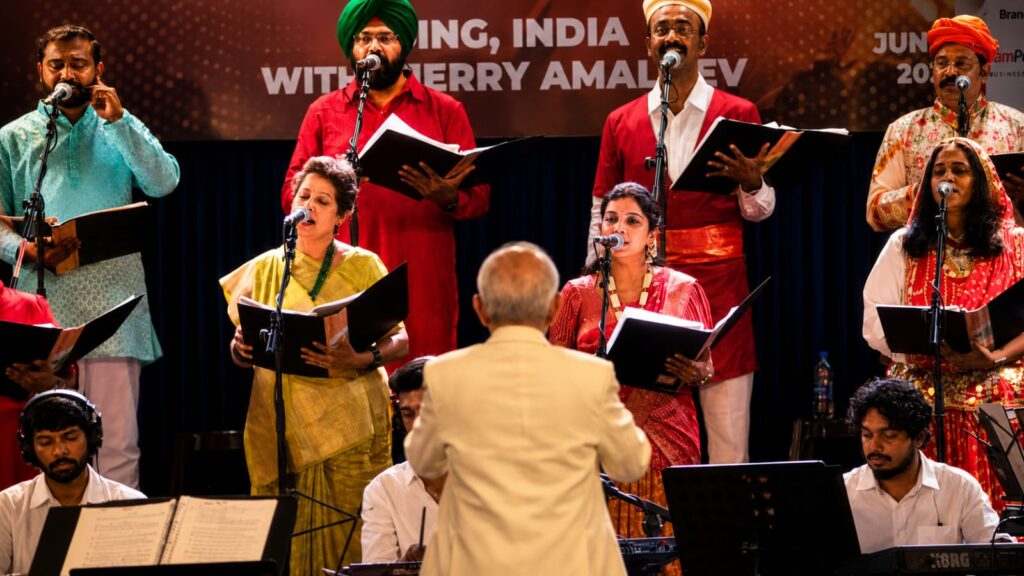
One could visualise the movement of a train as the number I a’m a train composed by Albert Hammond in 1974. A folk number, it was arranged in four-part harmony later by Peter Knight. The rhythms, noises and speed of the train could be faithfully produced by the choir.
Soon followed Poovattaka Thatti Chinni, Kannodu Kannoram, Manjanikkombil, Penninte Chenchundil, Oakkumarakombathe, Mele Mele Maanam and Pavizhamally before concluding with the evergreen song Aayiram kannumayi that elicited a standing ovation.
Jerry Amaldev, the conductor who speaks with his hands
Small wonder, Jerry, who conducted the show, was the cynosure of the event. Each musician in the choir followed the movements of his body as a whole, including his hands, fingers and even the facial expressions that evoked the very tenor of the song. At times, he could be seen inspiring some of the instrumentalists. Very often, the denouement was abrupt, which was indicated by the swift whirling of his hand in the air. In some other cases, the last single note of a composition was reflected by the folding of his little finger! That was awesome indeed. Really didactic was the short explanation by Jerry of the circumstances that led him to compose the musical score of each song.
Worth mentioning in this connection was the ingenuity with which Jerry improvised his own songs in Malayalam. True, each composition was presented as in the original. But he employed four-part harmony and counterpoint harmony to embellish, especially in the humming and BGM. This transported the listeners to an ecstasy beyond description.
SIwJA was the finale the CSI Church Choir’s prestigious programme Sanctua Voix, an online international choir competition which was participated by fifeen choirs across the globe. The winners were Sensu Chorale, Philippines (first prize) and Octect Maestroso, Kottayam (second).
The Bishop of Cochin Diocese of CSI Church Rt. Rev. T Kurian Peter distributed the prizes. The Philippines team appeared online and expressed their gratitude. Present among the dignitaries was also Dr Niji Justin, Mayor of Thrissur Corporation.