


Chidambaram’s Balan: The Boy is rich in atmosphere and technical excellence, yet its weak character writing and shaky dramatic logic leave it emotionally detached.
There is a certain kind of cruelty in a film that assembles all the right people and then squanders them. Balan: The Boy, directed by Chidambaram and written by Jithu Madhavan, is precisely that kind of film, polished almost to a shine, technically immaculate, and yet, somewhere between its beautiful surfaces and its dramatic core, strangely empty. Empty in ways its makers seem not entirely aware of.
Chidambaram is back with the same trusted crew that gave Manjummel Boys its authentic charge, and the line-up includes cinematographer Shyju Khalid, editor Vivek Harshan, composer Sushin Shyam, and production designer Ajayan Chalissery. By any measure, this is one of the strongest technical units working in Malayalam cinema today.
If you have watched Manjummel Boys or Jan E Man, you can see that Chidambaram favours image over explanation, and Shyju Khalid’s frames honour that instinct in Balan, especially in scenes where the boy’s loneliness fills the screen, the verticality of tree-lined paths pressing down on him with quiet, eerie force. Sushin Shyam’s score operates at the margins of silence, minimal and unsentimental. These are craftspeople of exceptional seriousness.
Which is precisely why it stings.
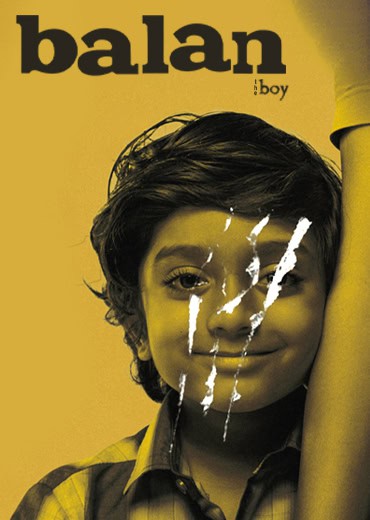
The film is best understood as a survival drama about an outlaw mother and child, one that does not accept easy moral judgements. The premise is genuinely compelling. A woman released from prison lives with her young son under assumed identities, moving from place to place, reinventing both their lives with each new location.
It is not exactly complex social realities that push her into this life on the run,the answer lies in the way she views the world around her. But when she disappears one day, the child is left to navigate and survive in a world he has only ever known through the stories his mother constructed.
At its best, Balan reminds one of the fugitive domestic dramas of Latin American cinema, the ethical greyness of Lucrecia Martel or the raw dispossession in Pablo Trapero’s work, or the moral ambiguity of filmmakers like Cristian Mungiu and Paweł Pawlikowski, who understand that surviving a broken system can push decent people into indecent choices.
But a visual grammar borrowed from the world’s great cinemas cannot do the harder, less glamorous work of dramatic construction. And that is where Balan finds itself, fatally, underprepared.
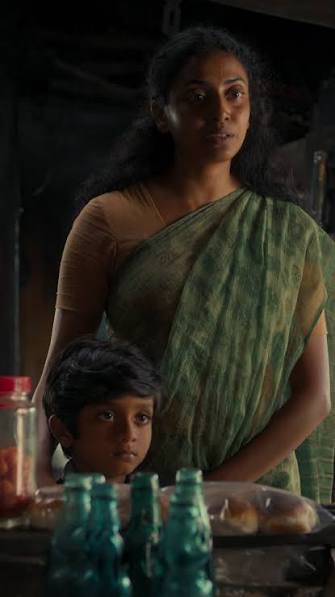
A mother, a child and a compelling beginning
Newcomer Farzana Palathingal, as the mother, carries the film without fuss. Her performance is not loud or overtly dramatic, it is internal, controlled, and deeply physical. Her eyes do more work than her body, moving between calculation, confusion, fear, helplessness, and a fierce, almost animal protectiveness.
She performs with the concentrated economy of someone who has been at this for decades. Young Aadisheshan K.R. matches her step for step, avoiding every known trap of child acting, no forced innocence, or no exaggerated tears. Dolly June, as an eccentric elderly woman, is the unexpected delight of the film, generating a disturbing warmth that makes you wish the screenplay had stayed in her orbit a little longer.
All of this is the good news. The bad news arrives in the second half, escorted by Tovino Thomas.
Casting Tovino as Abbas, a thief on the run who becomes a protective figure for young Balan, is not, in itself, a grave mistake, but it plays like a misfire. Stars can complement such films rather than overwhelm them, and Malayalam cinema has produced genuinely good cameos.
But Abbas as written gives Tovino almost nothing to work with. The prosthetics distract, the urgency drains away, his mission and motives are never established, and the narrative parks itself while his portion plays out. What should deepen the film instead stalls it. Worse, some scenes will make you regret not buying popcorn.
The more serious problem is that Abbas has no discernible motivation, no internal logic, no sense of himself beyond a series of reactions to other people. He is there as a plot convenience rather than a human being with specific hungers and contradictions. A character whose only function is to witness events and offer protection when required is not really a character at all. He is a placeholder wearing a face.

And then there is Pavithran, played by Jean Paul Lal. Lal is a performer of real force. He brings a cold, quiet menace to this morally compromised police role, and on screen he is hard to ignore. The problem is not the actor, it is the screenplay, which never tells us who this man actually is. We are told he is driven by personal revenge as much as professional duty, but the film never shows us the wound.
We never learn what he actually wants, whatever is offered as his motive sounds thin, not reason enough for the scale of what he has done, nor what he fears, nor what keeps feeding his obsession. He is menacing the way weather is menacing: threatening in atmosphere, but without any traceable cause. When the antagonist’s motivation is left blank, the stakes collapse. An audience can only sustain fear for so long before it starts asking questions the film has no intention of answering.
This is Balan‘s most serious failure, and it belongs equally to the writer and the director. Jithu Madhavan, the writer of Aavesham, and one of the more original voices of his generation, leans too heavily here on the idea that implication is sufficient, that if the mood is right, motivation can be left to the viewer’s imagination. Restrained storytelling, however, is not the same as incomplete storytelling.
This is the same problem that afflicted the otherwise beautifully made Eko, directed by Diljith Ayyathan and written and shot by Bahul Ramesh, though that film handles it considerably better than Balan does. Balan‘s second half suffers from the confusion between restraint and absence. The mother-son relationship that drives the first half with genuine anguish is gradually replaced by plot mechanics that never produce equivalent emotional weight.
There is also a question the film seems unwilling to ask itself: where does this actually take place?
Kerala is not a neutral backdrop. It is one of the most media-saturated states in the subcontinent, a place where a minor road accident can generate a dozen television news panels before the evening is out and where a woman changing names and identities across districts, apparently across languages, would draw scrutiny fast. The incidents of Balan depend on a kind of social invisibility that contemporary Kerala simply does not offer. Border-town settings are fast becoming a lazy cliché in Malayalam cinema, and Balan leans on that convenience without interrogating it.
The film is set in Kerala but behaves as if it were set nowhere in particular, and that inattentiveness costs it credibility at the very moments it most needs to be believed. This is not artistic ambiguity. It is a gap that pre-production should have closed.
These were fixable problems,the kind of holes that unhurried script development exists to catch, sessions where someone in the room is allowed to ask the awkward questions and where the antagonist’s logic is tested against human reality rather than plot requirement. Balan had the talent. It needed more time and honesty at the writing table.
Some commentators have called Balan a classic. Others have placed it in the company of world cinema’s finest, with a confidence that, in other circumstances, one might put down to first-week excitement. But something else is also going on, and it is worth naming.
Malayalam cinema has had a genuinely strong decade. Its best filmmakers have taken real risks, expanded their range, and earned international attention. But alongside those achievements, a secondary habit has developed, a kind of reflexive over-praise, triggered, one suspects, by years of sitting through indefensibly bad commercial films. When the baseline is low enough, even a competent film can look like a revelation. When films recycling tired, misogynistic formulas fill multiplexes without much pushback, a film that simply treats its characters as human beings can feel like a significant event.
To their credit, Malayalees have been engaging seriously with world cinema, films from Latin America, Romania, Thailand, Iran and beyond. That appetite is real. But Balan is a useful reminder that watching great films is only the beginning of the work. Admiring what Alfonso Cuarón or Asghar Farhadi do with a parent-child story does not transfer the skill. The fundamentals remain the same regardless of your influences: tell a story that holds together; give your characters something to want and something to be wrong about; build an antagonist whose damage you understand even if you cannot excuse it. The form can be unassuming or elliptical or formally strange, but underneath it, the story has to work.
Malayalam cinema may not be in crisis, but it is inside a bubble, maintained partly by real talent, and partly by an audience so relieved to be watching something halfway decent that it has started mistaking effort for achievement. The best thing criticism can do for a cinema this gifted is not offer more applause. It is to pay it the respect of being honest.