
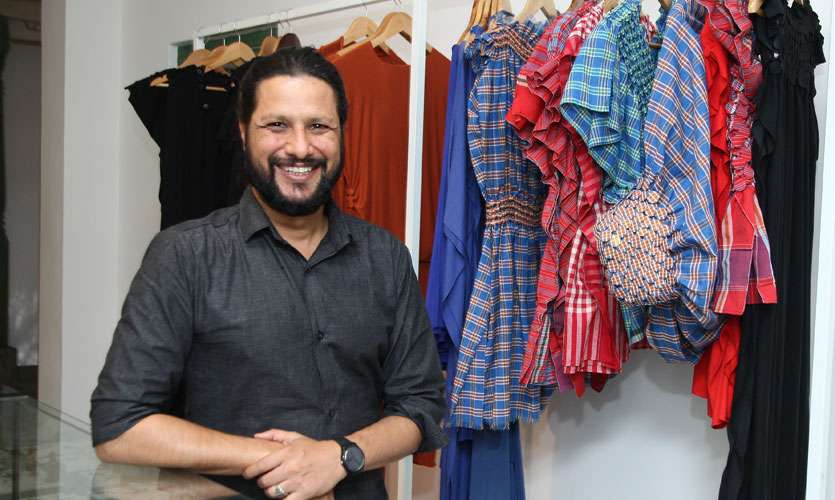
Trained at the National Institute of Design, Ahmedabad, Anuj Sharma is best known for Button Masala, a sew-free garment-making technique using buttons and rubber bands. Presented internationally, the practice is currently showcased at the Kochi-Muziris Biennale 2025, where Sharma frames fashion as a participatory process that blurs boundaries between craft, sustainability, and collective art-making.
How did the idea of button masala come about?
The Inception of button masala largely comes from two places. One is that I am from Rajasthan and second that I am a lazy person. Rajasthan allows me to use things wisely and smartly because there’s always minimal resources available. This scarcity of resources in Rajasthan always taught me how to use resources wisely. Being a little lazy also allows me to spend less and use less. The basic idea of button masala first emerged when I saw a man with a buttonless shirt on. So, I asked myself, what if there are many buttons and buttonholes? Mistakes will become patterns and based on that, I did a concept which was button and buttonhole space. With the combination of button and buttonhole, I was able to make a lot of variation in clothing. Button and buttonhole, transformed into buttons and rubber bands as the rubber bands replaced buttonholes. The rubber band was tied on to buttons of the fabric creating unique designs. We are basically tying the buttons into the fabric on to anything that doesn’t tear the fabric.
Could you tell us about this particular work that you are currently creating live during the biennale?
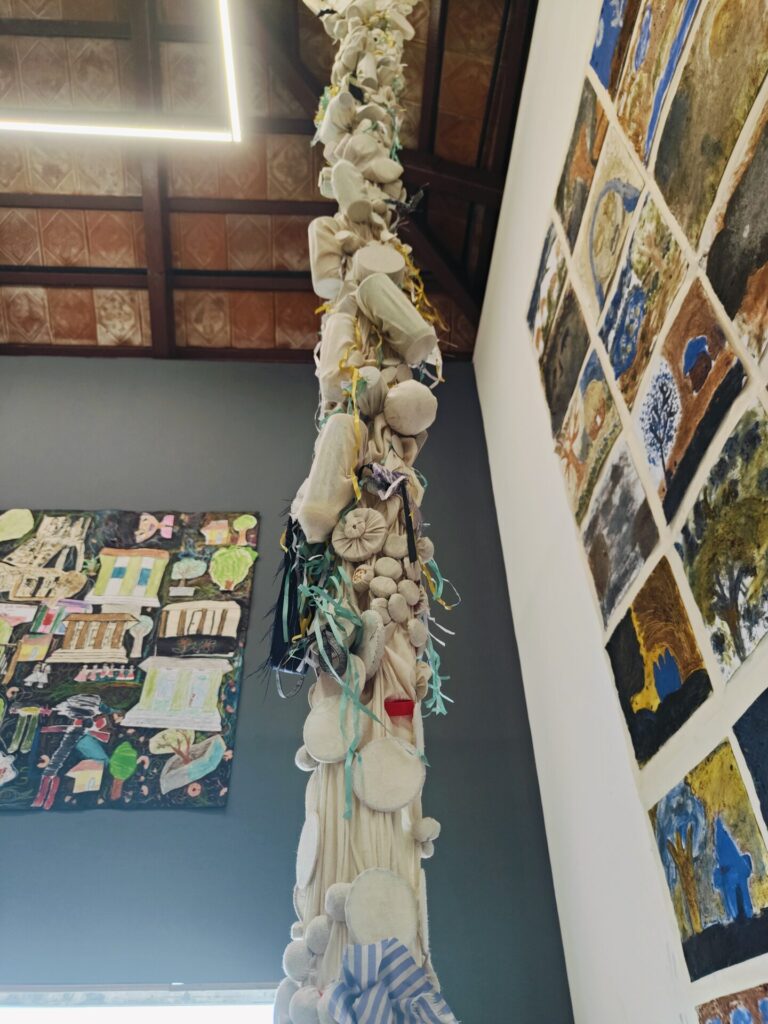
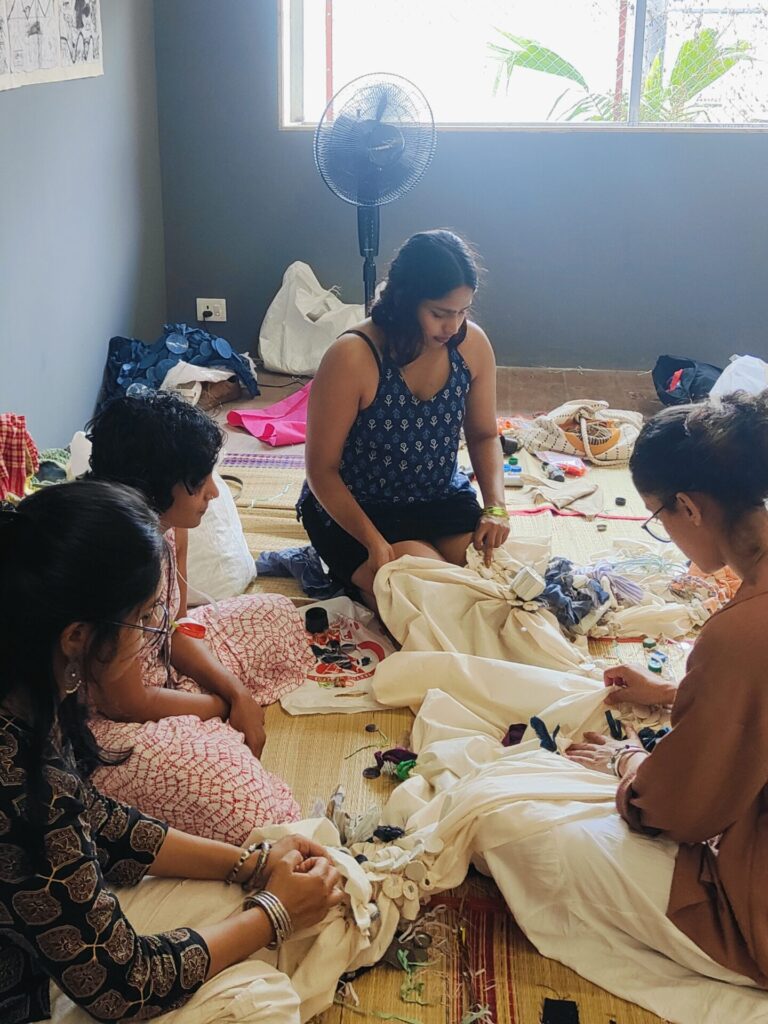
This work is produced using waste fabric collected from the city, two days prior to the biennale. We then put together an art piece, contributed by many, although the work is still in progress. This particular piece is just one of many. We have also trimmed garments out of these and hung it here. We will keep changing the artefacts on display.
You were among the early voices to present a TED Talk in India in 2010. How did it change people’s perception about button masala? What did that moment mean for you as a designer?
I was a very popular fashion designer during the time, and they wanted to have a designer talk in Ted Talks. They invited me, but they weren’t sure how to execute it, as I had only just started about a year earlier. The idea was big, but it needed more work. Nobody expected me to give a talk like the one I did. Mine was pretty much one of the most comic, happy, fun, and entertaining talk event.
Instead of making the artwork yourself, you choose to let people create artwork. Are you encouraging people to get into the field of art?
I am not asking or inviting people to come into the field as such. I am just making the clear line that everybody is creative, not just the artists. To understand that you are an artist, the process of creation, is important. Button masala provides a space for this.
We know that textiles have historically been treated as craft rather than art. What is your opinion on that?
It depends on the context. Craft and art are not very far apart. Today, art is often understood as something meant to be displayed—something that goes on a wall. But in ancient India, art was not limited to this idea. Painting on walls, carving surfaces, and making sculptures were all part of artistic practice, deeply embedded in daily life. Art can be understood to be more visual than utile. Craft, is often defined by its usefulness—by its role in everyday living. But this usefulness does not separate it from art. The distinction between art and craft is not as rigid as we tend to assume today.
Do you see Button Masala as a creative area or as a brand?
It is certainly a creative space. While many people perceive it as a brand, the intention has always been to foreground creativity rather than business. The focus is always on teaching and artistic creations. We only sample limited focus at the business dimensions of Button Masala.
How has your experience of biennale been so far?
This is my third Biennale. I have become more educated about Biennale through my experience. My role as a creative artist and the work that I’m doing has also broadened. Familiarity makes it exciting and also sometimes boring because you’ve already seen the buildings and places. Earlier when I came, I went out to look for the buildings, but now, I look at the art. So, there’s been a shift in focus. There’s always something to add and something to remove from my experience here.