
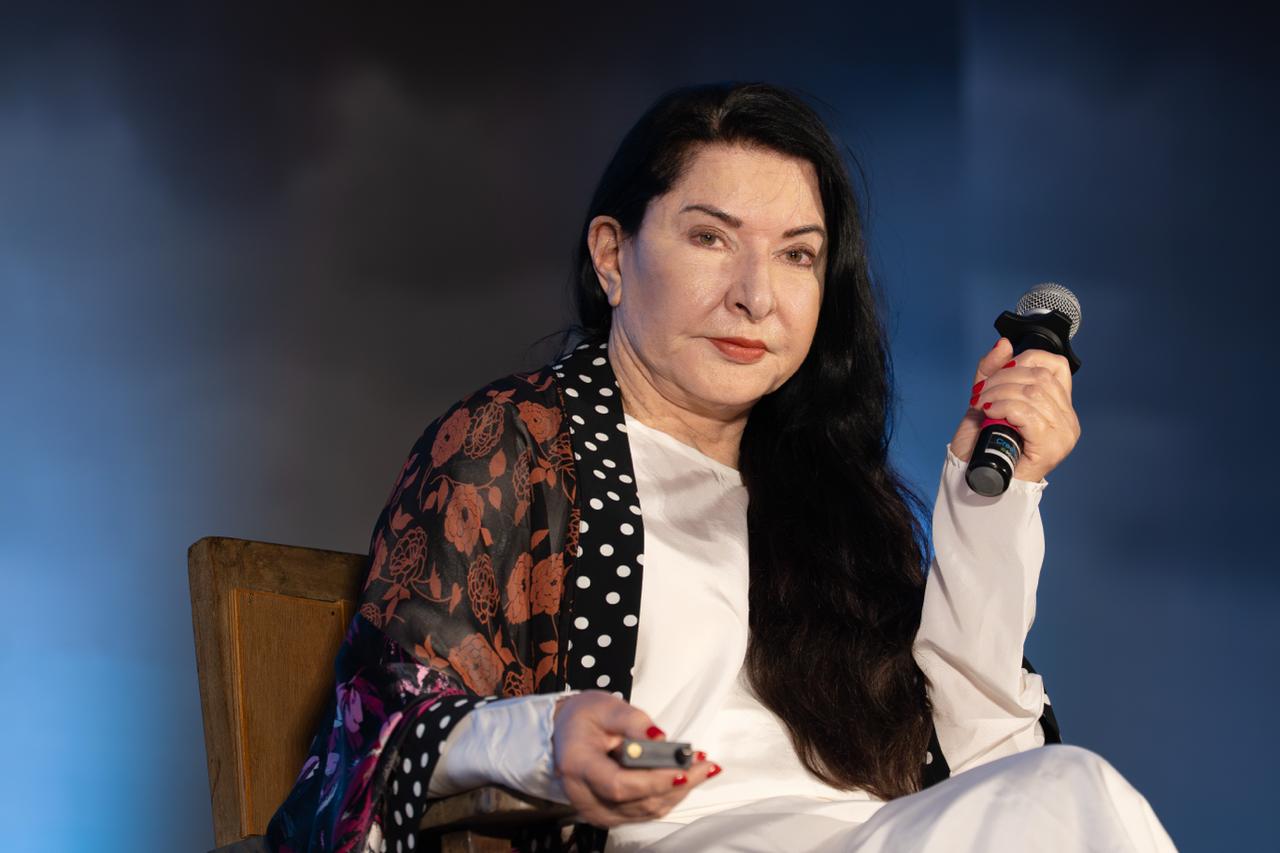
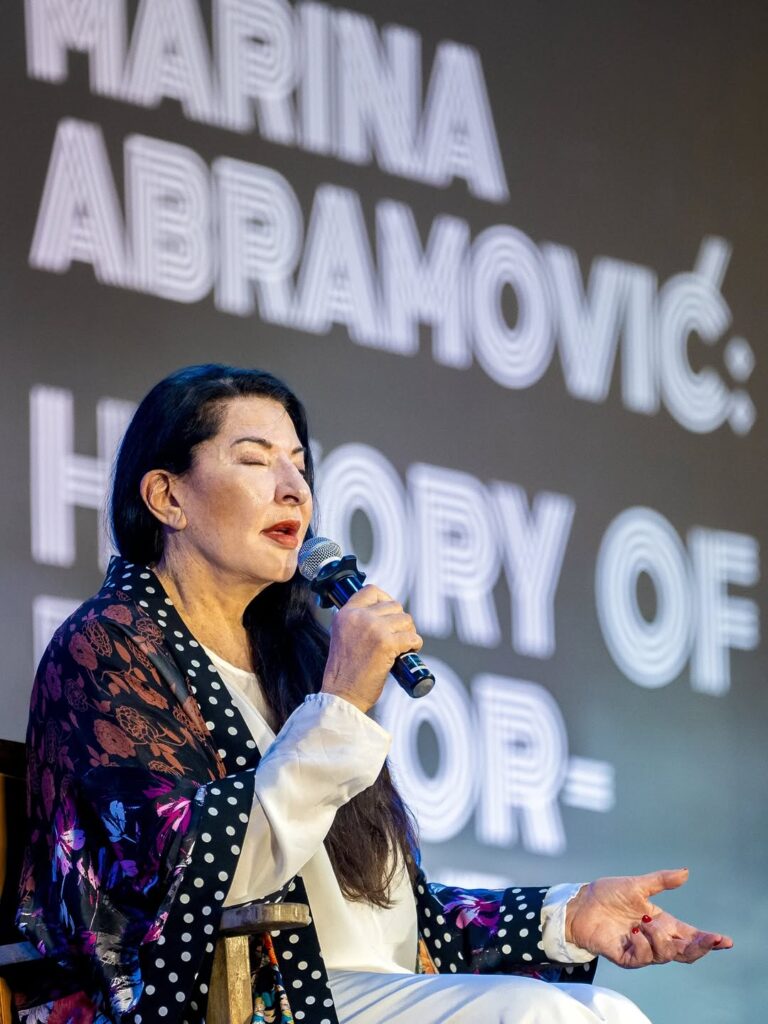
Marina Abramovic, widely regarded as the greatest contemporary performance artist, shines light into what performance really is. Through groundbreaking performances like Rhythm 0, Spirit cooking and Rest energy, she sets up high standards for performative art. In her recent lecture titled ‘History of performance art and MAI’, at the Kochi Muziris Biennale, she traces her journey in performances and how it transformed her spiritually.
In 1974, inside a dimly lit gallery at Galleria Studio Morra in Naples, Marina Abramovic laid 72 objects on the table—rose, honey, guns, objects of pleasure and asked her audience to use it on her body as they wished. They were devoid of any responsibility of their actions and thus were allowed to do anything as they pleased for six hours. This was her performance, Rhythm 0 which nearly killed her. She became canvas for the darkest human thoughts. For Marina such extremisms are become a methodology to redefine art through suffering.
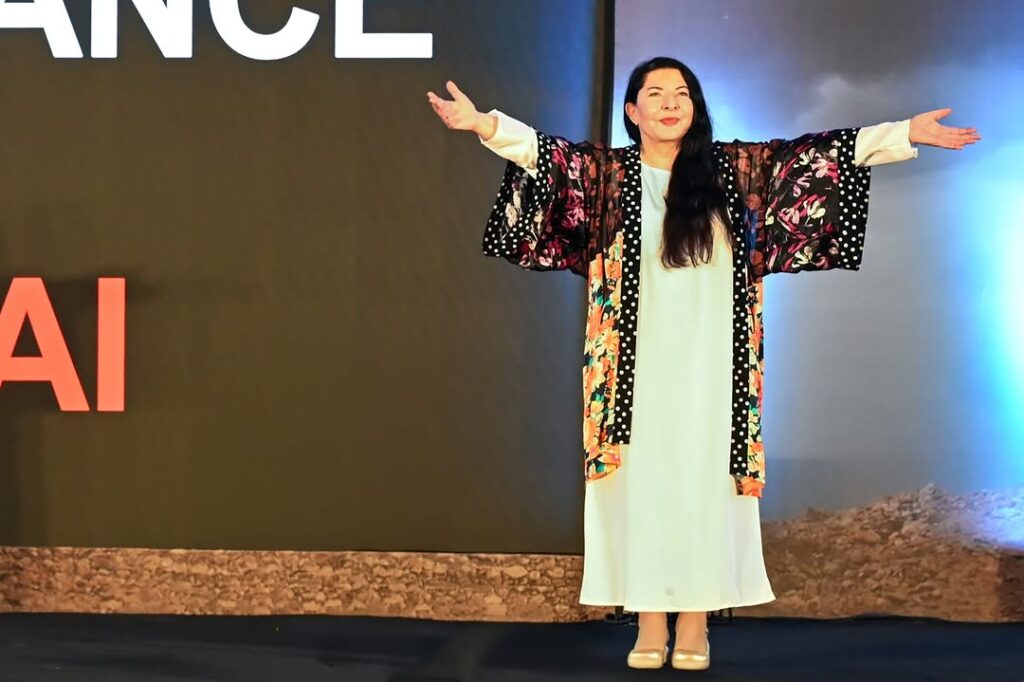
Cut to 20226, the standing ovation that greeted Marina Abramovic almost felt strange after decades of dangerous receptions. To the internationally packed audience at the Samudrika convention centre Willingdon Island, she made a promise, “Even if you know nothing about performance art, you will leave here understanding its essence.”
The first steps
Marina Abramovic’s journey began paradoxically from extreme restriction. Due to the suffocating parental control, even after finishing extremely dangerous performances she had to crawl back to her house in Yugoslavia, before 10 pm. Her critique of treatment of women by the socialist countries became fuel for her later performances exploring power, vulnerability and the female body.
India became Abromivic’s spiritual laboratory, she calls it “the big mother of the planet”. Gandhi’s idea—first, they ignore you, then they laugh at you, then they fight you and then you win has greatly inspired her to keep going.
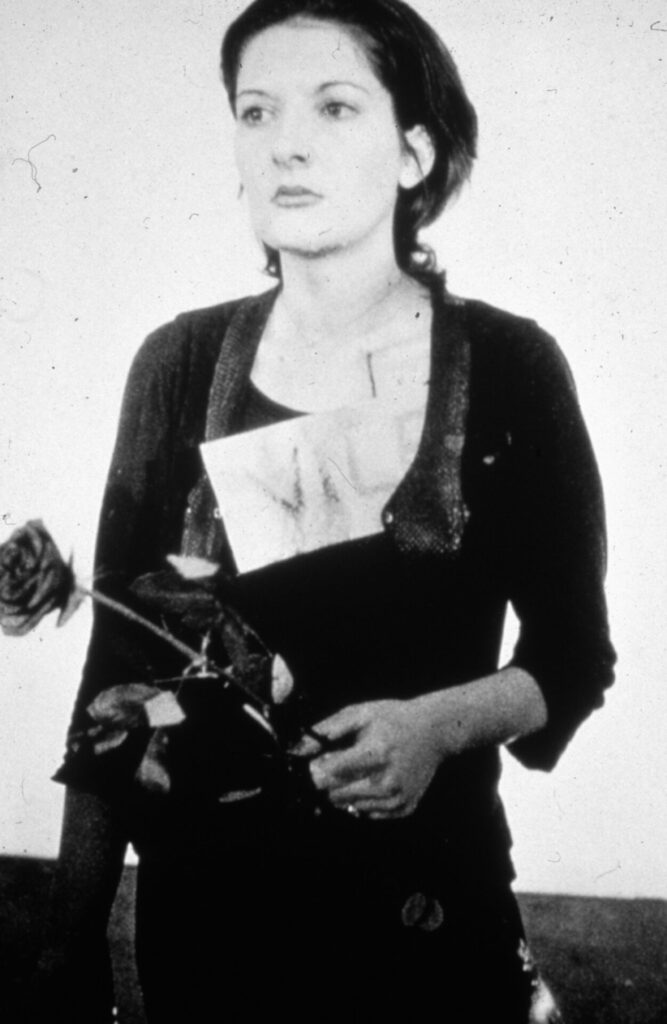
The whole focus of her first journey to India in 1975 was Bodh Gaya, to visit the bodhi tree where The Buddha attained enlightenment. The story of the Buddhas enlightenment became the starting point of her understanding of what to do in life. His decision “I’m not going to eat or drink anything until I reach enlightenment” made her realise how important it was to continue a performance even through suffering and pain.
These eastern pilgrimages of India and later Tibatan monasteries culminated in the production of ‘The Waterfall’, which was installed at the same venue where the lecture was taking place. The work is an assemblage of 120 Buddists chanting heart sutra which when layered together sounds like the sound of a waterfall.
For Marina Abramovic, authenticity precedes aesthetics. “Nature is my greatest inspiration” she says; not for beauty but for the unending cycle of creation and destruction. For her, her flesh and blood is her means of artistic expression.
Lineage of performance arts
The introduction to the lecture was followed by a masterclass in artistic genealogy. Marina Abramovictraced the evolution of performance arts through major figures like Bruce Nauman’s confrontational videos, Piero Manzoni’s subversive body works, and Joseph Beuys’ shamanic transformations. She took time on Cennino Cennini, an Italian painter and art writer’s, medieval rituals of preparation. He avoids eating meat for three months, avoids alcohol and abstains from sexual activities for a month and for three weeks he immobilise his hand by casting it in plaster, prior to the performance. “When he finally broke the cast,” she explained, “his hand could paint perfectly.
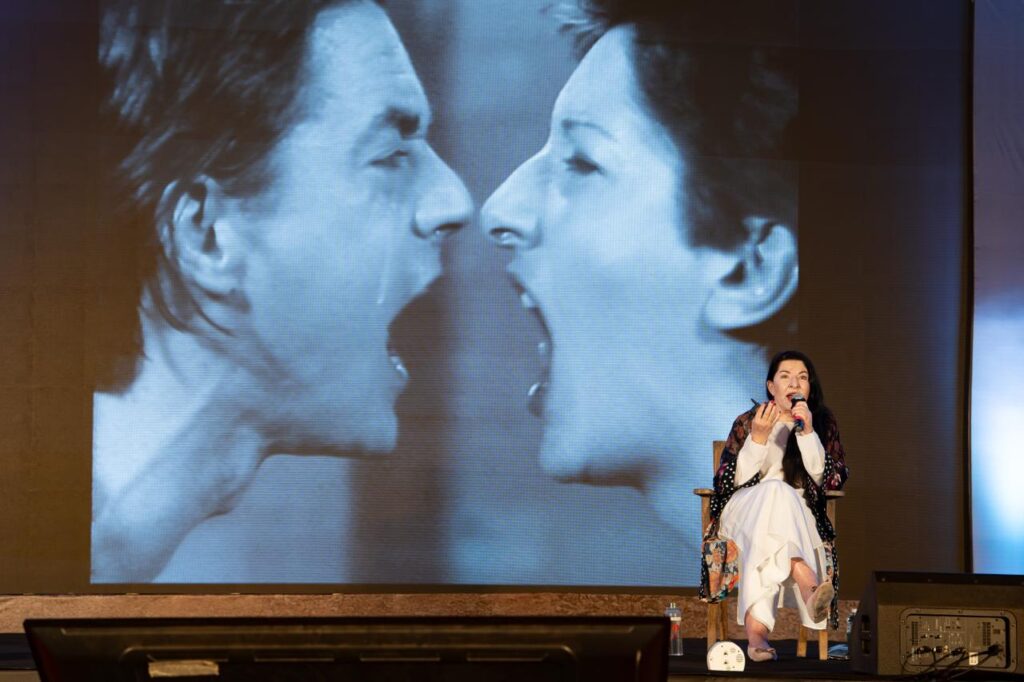
Body or the self become both brush and canvas in performance arts. She dissected Chris Burden’s ‘Shoot’—where he had himself shot in the arm with a .22 rifle, not as masochism but as radical materiality. “He eliminated traditional art materials entirely,” she noted. “Risk and pain became his medium.” Similarly, Mike Parr, an Australian performance and conceptual artist’s, ‘Reopening the Wound’ transformed past injuries into present performance, forcing audiences to witness the body’s memory of trauma made flesh.
Then came the durational performances of Tehching Hsieh, a durational performance artist. His year-long ‘cage piece’, 365 days locked in a cage for an year in a cage having only water bucket, toilet bucket, single bed and food delivered once daily. Tehching told Marina that he was able to achieve this great feet by dividing his bed into three parts and imagining them to be his living room, bedroom and garden. His ‘Time Clock’, was another performance where he punched a time clock every hour for an entire year, became a meditation on time’s tyranny and liberation. These weren’t just performances but extreme spiritual practices.
Abramovic’s own durational extremity came with ‘The Great Wall Walk’, where 2,500 kilometers was covered on foot by herself and her partner, Ulaim. They began at opposite ends of the wall, walking toward each other through desert and mountain, carrying their shared history toward its inevitable conclusion. They embraced at the middle for one last time and parted ways forever.
Rest Energy, a four minutes performance which for Abramovic felt like an eternity. Standing face to with her partner and a drawn bow and arrow in between them, their body weight and trust were the only things that kept the arrow form piercing through her heart. The microphones captured their accelerating heartbeats as exhaustion made their grip uncertain. The piece ended when their hearts reached dangerous speeds.
The making of a method
The initiation for Marina Abramović Institute [MAI] happened during ‘The artist is present’, performed at MoMa, New York. It transformed museum goers into performers setting up a space for self confrontation. Spectators were invited to sit across her and sustain eye contact with her. Suddenly the onlookers became performers and part of the artwork with people observing them and being photographed. Tears streamed as they encountered something rarely seen in contemporary life: undiluted presence. “They weren’t crying from sadness,” she observed. “They were crying from recognition—of themselves, of being truly seen.”
Abramovic wanted to create a space where they could transform their lives. MAI moves beyond a mare exhibition and transcends into a creative force. Audience become co-creators rather than spectators. The rituals at the institute—counting rice, walking backward with a mirror, blindfolded listening and blindfolded nature immersion strips away performance art’s spectacular violence to reveal its meditative core. The institute works as a medium to transmit her spiritual awakening to others.
On Abramovic’s instruction, the evening culminated with seven minutes of sustained absolute silence. She asked audience to be fully present. The stillness was broken by a standing ovation serving as the evening’s curtain raiser.