
On World Music Day, Ustad Waseem Ahmed Khan of Agra gharana speaks on inherited voice, monsoon ragas and what it means to keep a tradition pure while making it one’s own.
Among the most distinguished voices carrying the Agra gharana into the present day, Ustad Waseem Ahmed Khan stands seventeenth in a lineage that has shaped Hindustani classical music for generations. His singing is marked by a powerful, open-throated tone, intricate layakari and a gayaki steeped in the dhrupad sensibilities that define the Agra tradition.
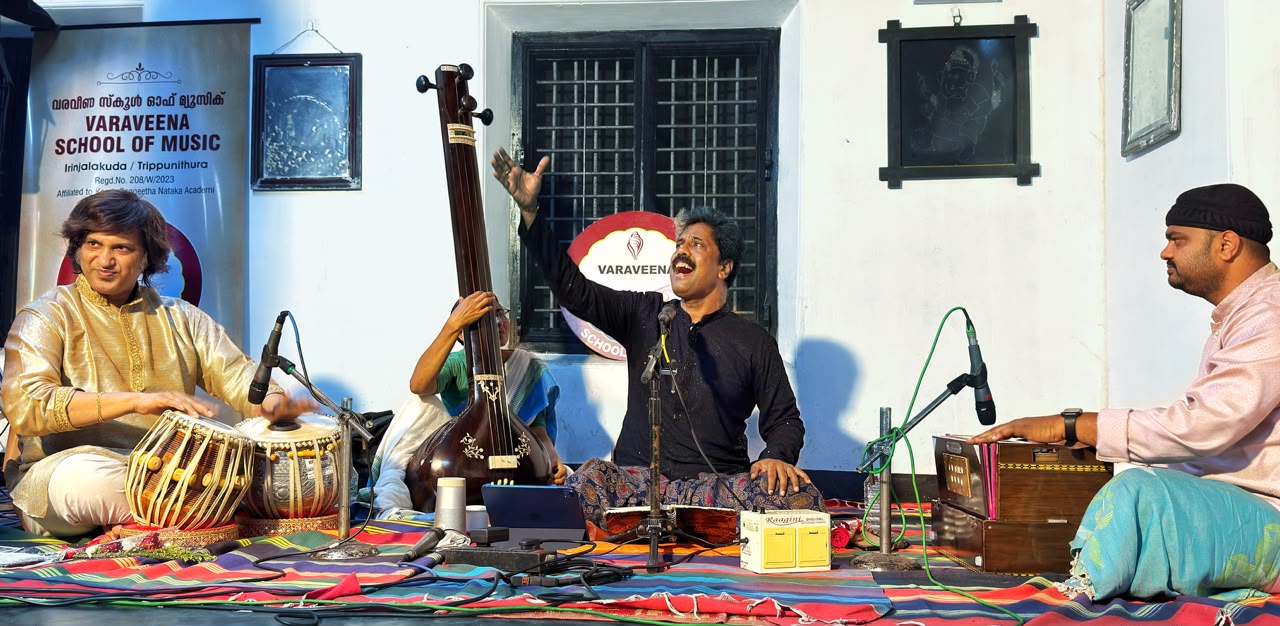
He brought that same sensibility to Tripunithura recently, where a monsoon-themed evening hosted by Varaveena Music School, set within the walls of a historic palace, found him drawing out the moods of the Malhar. In the conversation that follows, Khan speaks on inheritance and individuality within a gharana, on the discipline behind the open throat, and on what it takes to keep a centuries-old tradition both intact and alive.
You started learning music under your grandfather Ustad Ata Hussain Khan and then from your father, Ustad Naseem Ahmed Khan. How did their approaches to training shape you as a musician?
Ustad Ata Hussain Khan, my grandfather, started my talim, but he passed away when I was about six-and-a-half years old. My father then took over my training. I heard a great deal about my grandfather from my father, who was his disciple.
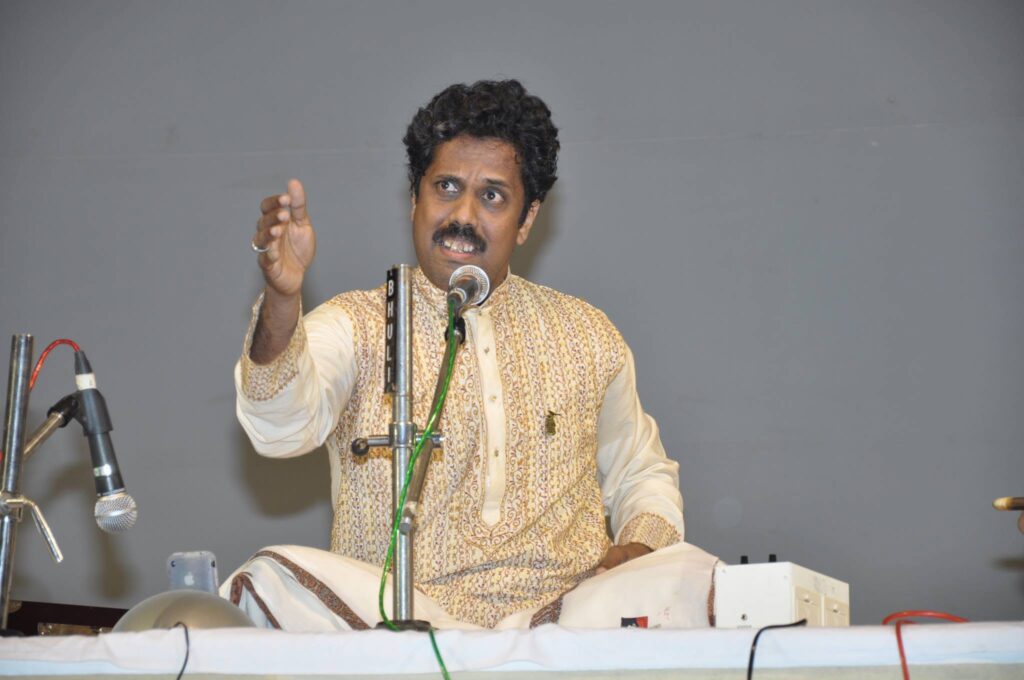
From everything I have heard, my grandfather was an extremely simple and humble person, with no trace of showmanship. He was devoted to teaching and known for his discipline. I directly learned only one bandish in Raga Yaman from him.
After that, I learned from my father for about 18 years. He was also an excellent teacher. The difference was that he was a little more lenient with me because I was pursuing my studies alongside music. My grandfather had given him clear directions regarding my musical education, and he carried that responsibility forward. Most of my talim came from him.
I still remember that just a week before he passed away, he taught me a bandish in Raga Kamod, “Lageere Mori Nayi Lagaan”. I was also blessed to learn from my maternal granduncle, Ustad Shafi Ahmed Khan, under whom I studied for nearly eight years. He taught me many ragas and dhrupad compositions. God has been very kind to me in giving me such great gurus. Whatever I am today is because of their guidance and blessings.
How do you define Agra gharana’s identity, and what responsibilities do you feel as its carrier?
Agra gharana is one of the oldest traditions in Hindustani classical music. I would define its identity as being staunch, rooted and pure. Every gharana is pure in its own way, but Agra has a very distinctive character.
It has strong dhrupad roots. Earlier it was primarily dhrupad, and later khayal also became part of it. We retain many dhrupad elements in our gayaki. The nom-tom alap, the robustness of the taans, bol-taans, pukars and bol-baant all come from dhrupad. Our gurus beautifully integrated these elements into khayal singing, and that has become a defining identity of the Agra gharana.
As for my responsibility, my father devoted his life to taking this music across India and the world, and my gurus did the same. I feel it is my duty to pass on what I have learnt from them. This gayaki is not easy. One has to dedicate time, hard work and sincere effort to understand and preserve it.
As a performer, I also feel responsible for maintaining the quality and integrity of what I have inherited. I cannot dilute the style. The foundation of the gayaki must remain unchanged. At the same time, every artist should bring his own mind and imagination to it. If we merely copy our gurus, there is no individual identity.
The structure and identity of the Agra gharana must remain intact, but within that framework we can contribute our own thoughts and creativity. That is how a tradition remains alive while staying true to its roots.
Agra gayaki is praised for open-throated singing. How do you train your voice to achieve this? What practice routines do you follow?
The open-throated voice is one of the defining characteristics of Agra gayaki. My gurus always told me not to make the voice artificial, especially during morning riyaz. They would say, “Sing openly, with an open throat.”
In the Agra gharana, singers have traditionally sung with an open throat. But that does not mean singing without refinement. One has to maintain complete control over the voice. One can use all the ornaments and nuances of music, but the voice should remain open and natural.
Whatever I have achieved comes from the training I received from my gurus. As a child, I would do riyaz every day from six to eight in the morning. My father constantly guided me on voice control, how to execute murkis with an open-throated voice, and how to reach the upper saptak while maintaining clarity.
Voice culture and voice control are extremely important in the Agra gharana. Our daily practice includes open-throated singing, sustaining notes for long periods and various voice-control exercises. These are some of the methods we use to strengthen and enhance the voice.
You often sing Malhar ragas. What prepares you mentally for a monsoon raga? Do you ever perform Malhar out of season, and how does that feel?
I often sing Malhar during the monsoon. Of course, these ragas are traditionally associated with the rainy season, but many musicians perform them at other times of the year as well.
I remember an incident about two years ago when I was performing in Toronto, Canada. I was planning to sing Raga Purvi, as it was the appropriate time of day. But suddenly it started raining. People in the audience requested a Malhar because the atmosphere had changed so beautifully. So I changed my plan and sang Malhar. I have sung Malhar out of season as well.
Do you have any favourite ragas?
There are four or five ragas that I cherish deeply, but that does not mean I value the others any less. If I had to name a few, I would certainly mention Raga Purvi. It is one of my favourites because of its unique mood and atmosphere.
Another favourite is Lalit. What attracts me to Lalit is its early-morning character and the use of the two madhyams. Their interplay creates an atmosphere that takes you into another world. It is difficult to explain in words, but when those phrases unfold, they evoke a very distinctive feeling.
Agra style often uses nom-tom alaap. What do you focus on when practising nom-tom?
Nom-tom alaap comes from the dhrupad tradition. When practising nom-tom, one of the most important things I focus on is the clarity of the syllables. The audience should be able to hear and identify the individual sounds clearly and appreciate their musical and rhythmic character.
Another important aspect is maintaining the traditional dhrupad quality of the alaap. In dhrupad, murki is generally avoided. However, in the Agra gharana, we sometimes take a little liberty and introduce subtle ornamentation where appropriate.
That ornamentation should be used very carefully. It should not become so prominent that the nom-tom loses its original character. The essence of the form must remain intact. So, when practising nom-tom, I focus on the clarity of the syllables, the purity of the swaras and preserving its dhrupad foundation. Any rhythmic play or ornamentation should enhance the presentation without overshadowing its basic structure and identity.
Do you maintain the old gurukul method of teaching, or have you adapted to modern methods like online lessons? How do you see the future of teaching classical music with technology?
Yes, I do try to maintain aspects of the old gurukul method, although it is not always possible today for a student to live full-time with the guru. One of the most important features of the gurukul system is one-to-one teaching. I have always preferred teaching students individually rather than in large groups. Personal attention is essential in Hindustani classical music.
Some of my students stay with me for periods of time, while others spend several days at my home for intensive training. They become part of the household, and teaching often extends beyond formal class hours. This closeness between guru and shishya is an important characteristic of the gurukul tradition.
At the same time, we have to adapt to modern realities. Students living in the United States or other countries cannot always come and learn in person, so online teaching has become necessary. I do teach online, but generally it is more suitable for advanced students who already have trained voices and a good understanding of music.
For beginners, online learning has limitations. In the initial stages, a student may need to practise a single bandish or a few phrases repeatedly for weeks or even months under close supervision. That kind of guidance is often more effective in person.
Technology is a useful tool when used properly. The same applies to electronic tanpuras and digital practice aids. When travelling or staying away from home, students may not have access to a traditional tanpura, and technology becomes very helpful. However, students should also learn how to tune a traditional tanpura and do riyaaz with it at home. Like everything else in music, balance is essential. Technology should assist the tradition, not overshadow it.