
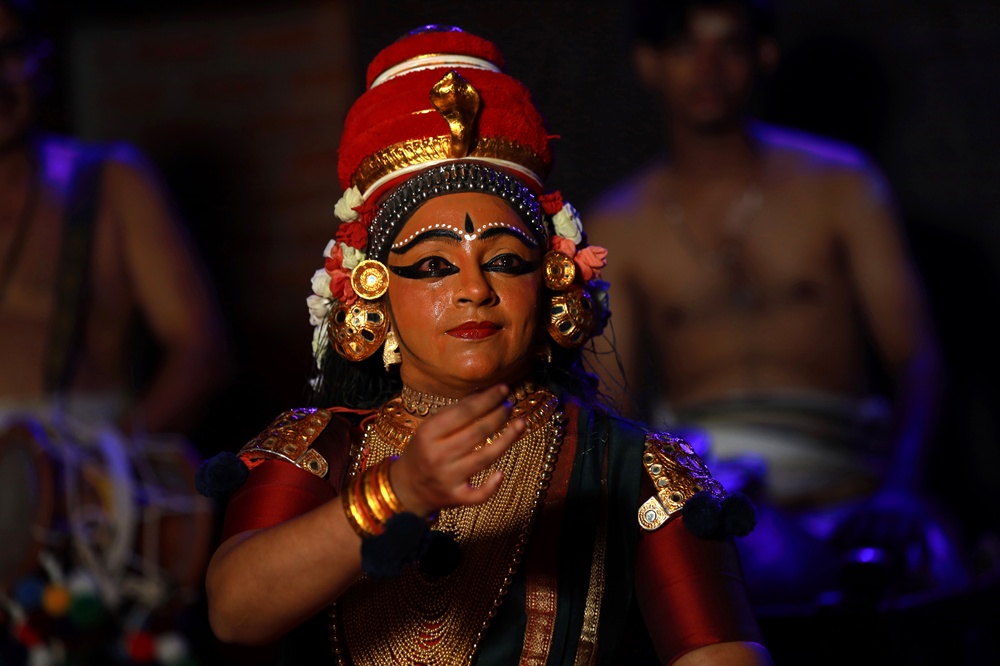
G Venu’s Chakra Natanam explores the seven chakras through Kutiyattam, with Kapila Venu bringing the spiritual vision of Soundarya Lahari to life.
Natanakairali, instituted by Guru G Venu, has turned into a veritable laboratory of Abhinaya techniques over the years. Innumerable productions that have rolled out from this unique institution stand as testimony to the unfathomable research of Venu in traditional art forms, especially Kutiyattam.
To mention a few, when Kalidasa’s Abhijnana Sakuntalam—that was an anathema to the traditional performers of the theatre form, viz., Chakyars—choreographed by Venu won encomiums for him across the world. Recently, when Mriccha Katikam, attributed to King Sudraka, was produced in Kutiyattam, it was invited to be staged in all the major cities, which spoke to its wide popularity. Moreover, the ingenious technique of abhinaya, ‘Navarasa Sadhana ’, which is being attended by performing artistes of all hues, is an index of his ardent passion for research. Admittedly, the present batch currently in progress at Natanakairali is the 143rd one.
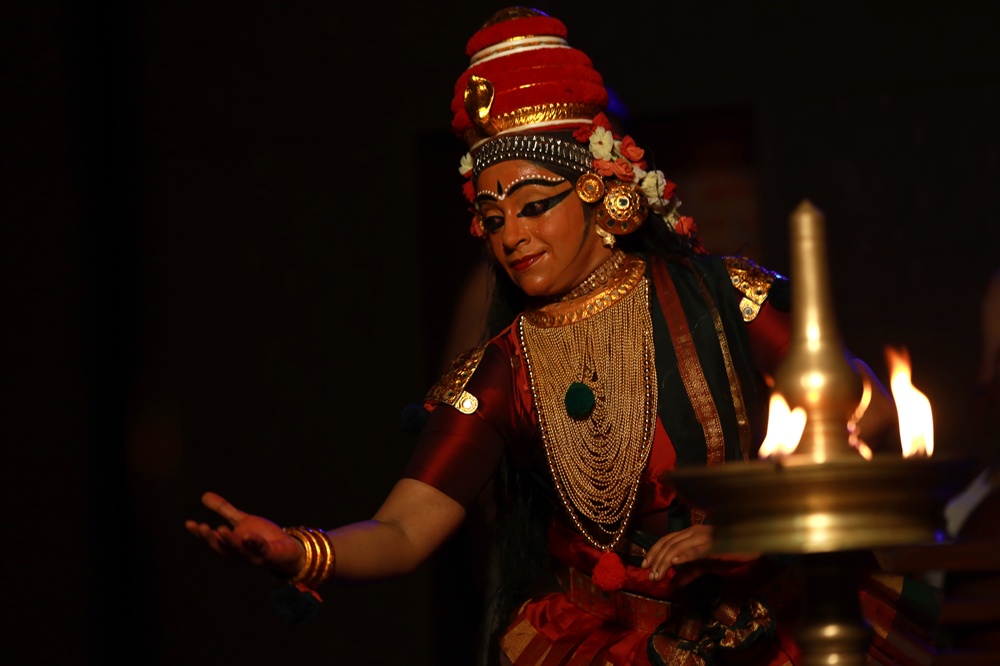
The latest production, ‘Chakra Natanam’ (Dance within), based on Sankaracharya’s Soundarya Lahari, was presented before an invited audience recently. Soundarya Lahari, a Tantric and spiritual work, had captivated Venu’s interest for a long time. This compelled him to choreograph the first sloka in Nangiarkoothu more than a decade ago at the Paramekkavu Agrasala, Thrissur. Performed by Kapila Venu, his daughter, it won acclaim from reputed scholars who advised Venu to embark on more slokas. As part of the ‘Netra Ragam’ series, in which further research is going on, Kapila staged it in Kutiyattam as well.
Translating the seven chakras into Kutiyattam
Chakra Natanam was based on the 9th sloka that began with “Mahim… mooladhaare”. The concept of each of the seven chakras (centres of spiritual energy) in the body is presented through theatrical episodes drawn from the Puranas.
After the customary rituals, the actor looks down and arouses the Kundalini that lies coiled in three and a half circles and goes up. Thereafter she transforms herself into the Goddess, touches the Prithvi (Earth) and performs the ‘Kanduka’ dance – an ancient ball-dance which is the symbol of ‘Kama’ (the Cupid). Tears flow as she watches the divine image of Lord Shiva.
The principle of the Manipura chakra is water. Dark clouds appear in the sky, accompanied by thunder and lightning and also the rainbow, which is Indra’s bow. Braving the torrential rains, she goes into deep penance. The principle of fire is in the Svadhishana Chakra. As Shiva opens his third eye and begins to destroy the three worlds, she puts out his fire with her glances of compassion.
The Anahata Chakra entails air. It is the seat of all emotions. Conceived as a lotus with twelve petals, each of them carries a virtue. Purification is the principle of Vishuddha Chakra. Shiva is seated in Anja Chakra, radiating the combined brilliance of millions of Suns and Moons. The goddess meditates on Shiva alone.
Shiva is seated on the Sahasrara Chakra. She is seated on his left side. They melt into each other just like a river flowing into the ocean – the ‘Samyoga’ of Shiva and Shakti.
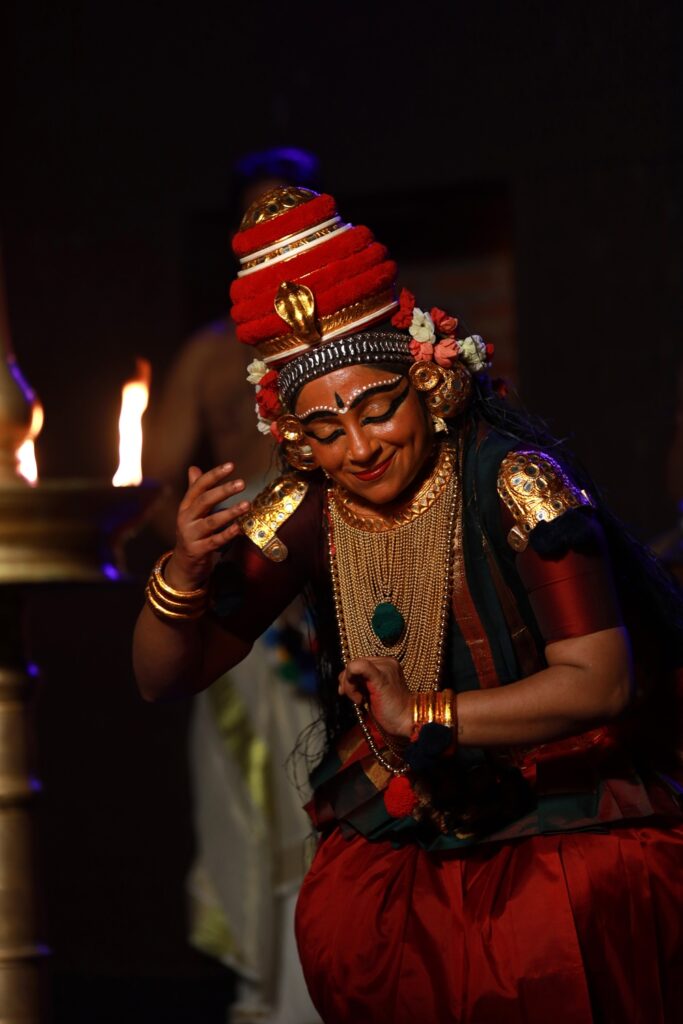
One could discern the histrionic potential of Kapila throughout. Her eyes were speaking a lot in each event. One could feel the heat radiated by the third eye of Shiva. Enactment of the virtues of the twelve petals of the lotus in Anahata Chakra, viz. happiness, love, unity, bliss, clarity, purity, compassion, realisation, authority, pity and patience, was elaborate. So was the event of ‘Palazhy Madhanam’ to mark purification under Vishuddha Chakra. The ‘Kanduka’ dance with balls was really appealing. An ancient ball dance which is the symbol of ‘Kama’ (the Cupid). Tears flow as she watches the divine image of Lord Shiva.
The principle of the Manipura chakra is water. Dark clouds appear in the sky, accompanied by thunder and lightning and also the rainbow, which is Indra’s bow. Braving the torrential rains, she goes into deep penance. The principle of fire is in the Svadhishana Chakra. As Shiva opens his third eye and begins to destroy the three worlds, she puts an end to it with her glances of compassion.
The Anahata Chakra entails air. It is the seat of all emotions. Conceived as a lotus with twelve petals, each of them carries a virtue. Purification is the principle of Vishuddha Chakra. Shiva is seated in Anja Chakra, radiating the combined brilliance of millions of Suns and Moons. The goddess meditates on Shiva alone.
Shiva is seated on the Sahasrara Chakra. She is seated on his left side. They melt into each other just like a river flowing into the ocean—the ‘Samyoga’ of Shiva and Shakti.
Kapila Venu’s expressive power
One could discern the histrionic potential of Kapila throughout. Her eyes were speaking a lot in each event. One could feel the heat radiated by the third eye of Shiva. Enactment of the virtues of the twelve petals of the lotus in Anahata Chakra, viz. happiness, love, unity, bliss, clarity, purity, compassion, realisation, authority, pity, and patience, was elaborate. So was the event of ‘Palazhy Madhanam’ to mark purification under Vishuddha Chakra. The ‘Kanduka’ dance with balls was really appealing.
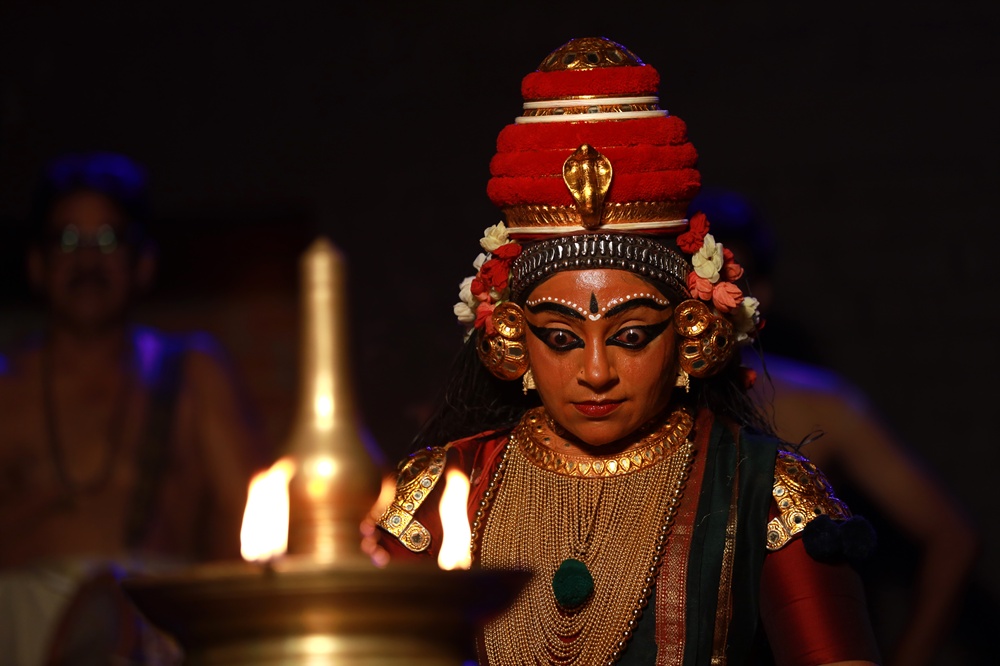
The role of percussion was commendable, with Kalamandalam Rajeev (mizhavu), Kalamandalam Hariharan (mizhavu), Kalanilayam Unnikrishnan (Edakka), P Nandakumar (Edakka) and Saritha Krishnakumar (taalam). One could hear the sound of the torrential rains and the water drops trickling down from Devi’s eyes in the deft drumming of the mizhavu.
Venu pointed out that Manipura Chakra represents fire according to the traditional descriptions, but in this interpretation of Soundarya Lahari, it is represented through the element of water.
The two-hour performance held at the Kottichetham Theatre of Natanakairali was watched by an audience including dignitaries, scholars and critics from far and near.