

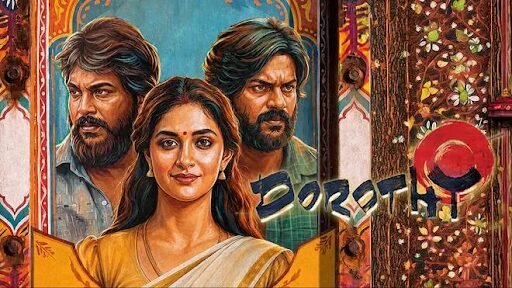
Karthik Subbaraj’s Dorothy challenges caste, masculinity, gender norms and friendship in a provocative Tamil film that leaves audiences questioning social boundaries.
Karthik Subbaraj’s Dorothy is a visually compelling and politically provocative Tamil film that explores caste, gender, masculinity, friendship, and love. Set in rural Tamil Nadu, the story revolves around Karthi and Subbu, two childhood friends whose relationship grows within a society governed by caste hierarchies, patriarchal expectations, and rigid notions of masculinity. Their friendship is unsettled when Subbu reveals her transgender identity, forcing Karthi to confront his deeply ingrained beliefs about gender, femininity, and male friendship.
Dorothy is political, certainly, but it is also immensely enjoyable cinema, thanks to S. Thirunavukkarasu’s cinematography. In parallel, Ilaiyaraaja’s score attends to tenderness, dread, and nostalgia, while Sananth and Rishikanth make Subbu and Karthi’s friendship effortlessly convincing. The film premiered at the Toronto International Film Festival before its theatrical release in India, and the critical responses since have been varied.
Some have celebrated it as a daring challenge to caste, patriarchy, and gender; others have questioned whether its methods occasionally reproduce the violence and stereotypes it wants to dismantle. That disagreement feels appropriate for a film that continually asks its audience to reconsider what they think they are watching.
Boys don’t cry
“Boys don’t cry” is hardly an unfamiliar phrase. In Dorothy, however, it becomes part of a larger education. Softness becomes feminine, and femininity becomes weakness, followed by weakness inviting humiliation. The lesson passes from one man to another until masculinity begins to look less like an identity than a performance everyone is terrified of failing. However, Subbu cannot retain rage as the natural language of masculinity. He cries, recoils from violence, and his softness keeps returning.

The film’s politics of caste are interspersed into this masculine world, where Karthi’s lower-caste position repeatedly determines where he belongs and how far he may enter Subbu’s world. Caste even shapes the different kinds of proximity available to the characters: who belongs inside the household, who remains outside it, and whose life can be sacrificed to preserve honour.
This is where Dorothy becomes more ambitious than a straightforward story about accepting a transgender person. Subbu’s struggle takes place in an interconnected network of caste, family, gender and violence that has already determined what a respectable “man” should be.
Similarly, Subbu’s family, which has consistently looked down upon Karthi because of his caste, turns to him to kill Subbu after her transgender identity is revealed. Subbu’s upper-caste status offers little protection when her gender identity is perceived as a threat to family honour. In this moment, Dorothy exposes how caste and gender hierarchies reinforce one another and how the preservation of social respectability can become more important than kinship itself.
When Subbu steps out
The moment Subbu appears in a sari is among the film’s most striking visuals. The family stares at Subbu as though they have encountered something monstrous after the film has spent so long showing us where monstrosity actually resides.
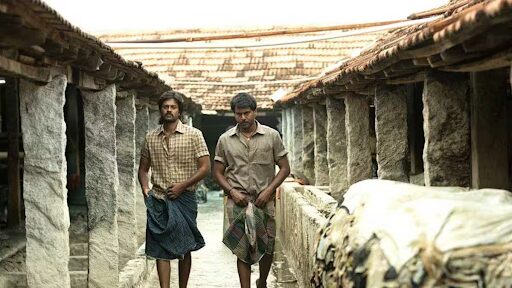
After Subbu’s revelation, there appears to be a change in the character’s mannerisms: in gesture, movement, and speech. Had Subbu been disciplining these parts of the self all along, and were we finally seeing the freedom of no longer having to perform masculinity? Or when the film needed Subbu’s transgender identity to become immediately visible, did it reach for familiar mannerisms through which Indian cinema has long taught audiences to recognise a trans person? There may be no easy answer.
However, this uncertainty becomes significant, particularly because cinema has carried a long history of reducing transgender characters to caricature, ridicule, or spectacle. Dorothy clearly moves beyond that history, and its treatment of Subbu has consequently been praised as a significant intervention in mainstream Tamil cinema. At the same time, questions about how trans embodiment is made legible on screen have formed part of the critical response to the film itself.
Friendship, grief and an impossible leap
One of the film’s most poignant moments lies in Karthi’s struggle to reconcile the Subbu he has always known with the person Subbu reveals herself to be. The friend is alive, but the version of Subbu whom Karthi believed he knew has disappeared. Karthi plays this confusion beautifully, as his character must confront the possibility that loving a friend does not give him the right to determine who that friend should be. This alone is an enormous journey for Karthi. It is also why the film’s final moment gave me pause.
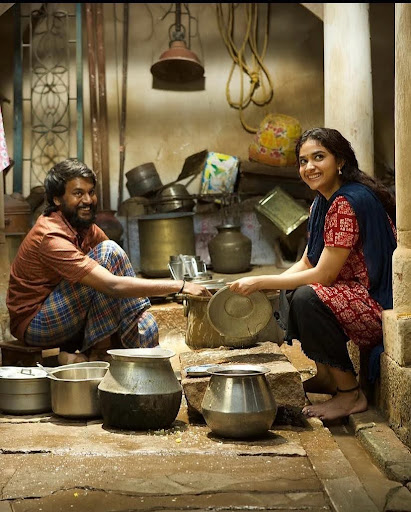
I could believe Karthi missing Subbu, his return, and finally embracing his friend without demanding that Subbu return to who he once was. Given how deeply Karthi has internalised the film’s codes of masculinity, even that recognition would have constituted a radical change. The change from recognition to romantic love, however, happens rapidly. I was less convinced that Karthi, within the film’s compressed emotional timeframe, had travelled all the distance required to arrive there. However, the more I think about the ending, the less certain I am that I would want Subbaraj to have chosen the safer alternative.
When the theatre fell silent
For most of the film, the theatre was alive. People laughed, responded to the performances, enjoyed the humour and surrendered themselves to the film’s storytelling.
Then Karthi and Subbu kissed in the end, and the cinema hall went quiet. I cannot know what everyone around me was thinking. Surprise, discomfort, embarrassment, emotion, and simple concentration can all produce silence. But the change in atmosphere was palpable. For the first time that evening, I became as conscious of the audience as I was of the film. And perhaps this is where Dorothy shows an apparently implausible leap. Had Karthi simply returned and embraced Subbu, the film could have concluded with a familiar and reassuring idea that friendship survives difference. It would have been moving, progressive, and ultimately safe.
The ending of the film changes the question from whether a man like Karthi can accept Subbu as his friend to whether the boundaries separating masculinity, friendship, gender, and desire are quite as secure as he, and perhaps some of us, had assumed. Probably, that is why Dorothy has provoked admiration, discomfort, criticism, and debate in almost equal measure. I walked out of the cinema hall still uncertain as to whether I entirely believed its ending. But I believed in the importance of the film taking us there.