
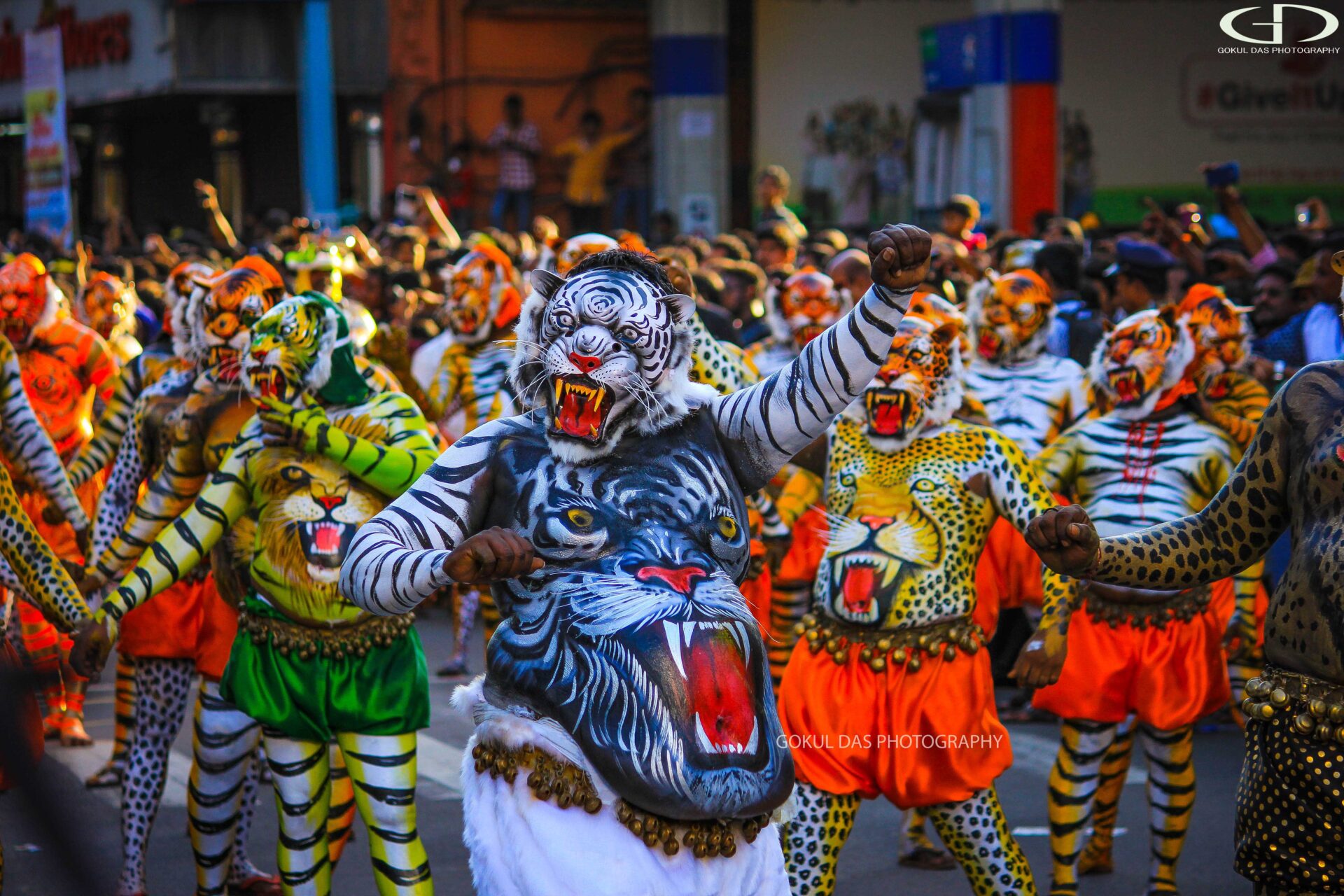
Just two days ago, the heart of Thrissur once again pulsed to the thunderous beats of chenda and the roar of painted tigers as Pulikkali—the much-loved folk spectacle of Onam—unfolded around the Thekkinkad Maidanam in Kerala.
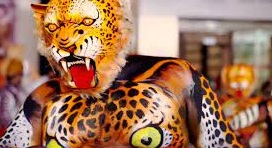
Where as the Kerala Forest Department struggles with the task of containing tigers that stray into human settlements, Thrissur celebrated Onam with a contrasting image—nearly 500 tigers dancing in harmony with crowds of people. These “tigers” were, of course, men transformed through the skilled brushstrokes of painters, but their presence offered an image of peaceful coexistence between man and beast, at least in the symbolic realm.
That is Pulikkali—the tiger dance—that never fails to captivate spectators across class, community, and even national boundaries. Staged annually on the fourth day of Onam, Pulikkali is unique in scale and spirit to Thrissur, the only venue where it is performed on such a grand stage. Its setting around the Thekkinkad Maidanam, once believed to be dense forest, adds to the symbolic depth of the event.
Though there is no such strict choreography for the movements of the Pulis, they exhibit hair-raising feats inspired by the ecstatic rhythm of tripuda.
Animal mimetic dance is as old as humanity, arising from imitation of Nature by man during the primordial days, For, Nature was his guru. The Thrissur version hogged international attention, being a striking paradigm of the largest flesh-painting exercise that has survived the onslaught of modern civilization. Nowhere on earth the human body is painted so extensively as it is done here.
Origins and legends of Pulikkali
As for its origin, it is believed that it was introduced by the Tamil-speaking Muslims as part of the Moharram festivities. The legend of Ali, son-in-law of Prophet Mohammed, is said to have close links to the performance. Ali was a great warrior and the Islamic faith portrays him as the guardian angel of the Almighty, possessing the strength of a tiger.
Gradually, the Muslim population lost interest in the play. Communities of Konars and Chettyars of Tamil origin took it up as they were used to the puliyattam , the Tamil version held during Pongal.
When it was introduced as a pageant, Pulikkali entailed miming the gait of a tiger which moves on its hind legs. The free hands enable the actors to execute various feats, both terpsichorean and acrobatic.
Spirit beyond spectacle
In the past, the use of olakka (pounding rod) was common. This helped them to display acrobatic feats. But bizarre actions such as a puli biting and lifting a goat used to be demonstrated during the show. Anyhow such gory acts were discontinued owing to resistance from the public.
Though a non-ritualistic art form, a sense of tradition is seen during the preparations and performances. Seldom does the painting begin without lighting a traditional lamp. The artistes invoke the blessings of their “creator’ – the painter. A visit to the nearby temple is a must before the play begins. Breaking of coconut at the feet of Ganapathy at Naduvilal junction on the Swaraj Round is scrupulously followed by all the pulis as they parade past this spot.
Donning up an artiste is a laboring, time consuming exercise that commences on the eve of the fourth day of Onam. Interestingly, drum beats heard from different quarters herald these activities.
The make-shift green room virtually turns into a beehive by nine in the previous night. Tempera powder mixed with varnish fill the earthen bowls and the first coat of white is applied. Designs of the skin of leopard, Bengal tiger, black panther, zebra lines etc appear on the body. All this time, surprisingly, the artistes are restrained from any form of relaxation.
Throwing up is common among novices, especially after the first coat. In such cases, they are allowed to lie down on plantain leaves. Excessive heat produced due to non-sweating is reduced by sprinkling cold water on the body.
Dubbed as an obscene exercise, many people in the past did not turn up to witness this annual event. Women’s presence among the spectators was limited. Moreover, financial constraints prevented the groups to participate in the show. But of late governmental agencies including the central and state and Thrissur Corporation stepped in
helping the groups. The police department was helpful in conducting the show in an orderly manner.
The show this year was perhaps the best in the recent times. The floats were quite attractive and many of them had messages including those against increasing tendencies for the use of narcotics. Puranic characters were many. Perhaps the most prominent one was a giant fish with the face of puli.
This year nine teams presented 459 pulis including a few female ones that added more attraction. After all, it is a demonstration of their jubilation over the annual homecoming of the dethroned king of Kerala, Mahabali.