
Indian classical music evolved through a cultural synthesis of Vedic and folk music traditions
Their common antiquity apart, the Vedas and Indian music are interrelated, as the latter owes its genesis to the former. Of the four Vedas, Sama Veda is regarded as the fountainhead of Indian classical music. Hence the relevance of the oft-repeated quote from our ancient treatises: “Brahma derived music from Sama Veda”.
The stages of evolution included those of Archika, Gathika and Samika, when monotonic, diatonic and tri-tonic notes were employed respectively in the Rig Vedic chantings. Of these, the first is only of theoretical importance, as monotonic music can beget nothing but monotony. As for the Samika prayoga, there have been attempts to establish that the three notes in it were ‘ri’ (Udatta, the raised), ‘ni’ (Anudatta, the lower) and ‘sa’ (Swarita, the middle). The three notes have influenced us so much that many institutions and industries related to music have been christened as ‘Nisari’.
But admittedly, there is no unanimity among scholars about the identity of these tri-tonic notes. A good many of them argue that the Samika prayoga included ‘ma’ (Udatta), ‘pa’ in the lower octave (Anudatta) and ‘sa’ (Swarita). The authenticity of this view springs from the structure of the Sama Vedic scale that evolved later.
The tritonic scale of the Rig Vedic period evolved into a full heptatonic scale during the period of Sama Veda. It was a descending scale, and the swaras were known in the order ‘Pradhama’, ‘Dwithiya’, ‘Tritheeya’, ‘Chathurdha’, ‘Athiswarya’, ‘Mandra’ and ‘Krusta’. These have later been identified as ma, ga, ri, sa, ni, dha and pa, in that order. That means ma (Pradhama) stood for Udatta, pa (Krusta) for Anudatta and sa (Chathurdha) for Swarita. When the lower tetrachord (pa, dha, ni, sa) in the Sama Gana scale was detached and placed above Udatta (ma), the full ascending scale from sa was obtained. The resemblance of this scale to Kafi raga in Hindustani or Kharaharapriya in the Carnatic system has been pointed out by scholars.
One may wonder how the equivalents of the Vedic note-names could be established.
The folk roots of the seven swaras
The poor musical quality of Vedic music as against that of secular music had been vouched for by scholars of those days. One of the Vedic composers himself compares “the drawling recital of Vedic hymns by the rishis and their disciples in the abodes of learning” to the croaking of frogs, while another equates it with the howling of jackals. Even Manu (3rd century AD), the great law-giver, disclaimed Vedic music for its impure sound. The Aryan priests, the architects of Vedic music, were themselves aware of this. Realising that the original inhabitants of the country had failed to accept Vedic music for its inferior quality, Narada (a Vedic priest and not the mythical character) accepted the note-names of Shadja, Rishabha, etc., used by the common people and established their equivalence mentioned above.
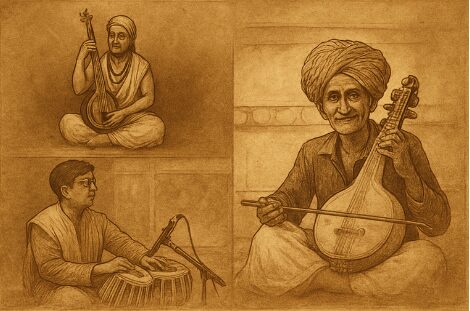
As for the notes used in Indian music, our sources tell us that they were sounds uttered by different birds and animals. Admittedly, this smacks of its irrefutable connection with Nature. “Shadja is sounded by the peacock and Rishabha by Chataka (the lark). The goat bleats Gandhara, and the heron cries Madhyama. In the season of flowers the Panchama is sung by the cuckoo. Dhaivata is croaked by the frog in the rainy season. Nishada at all times is trumpeted by the elephant” (Naradi Siksha). We also find Chataka substituted by the bull during later years.
Thus, it seems that during this period of cultural synthesis of pre-Aryan and Aryan elements, the Aryans borrowed the history of the note origin from the local people and assimilated it into the theory of music that was in the making.
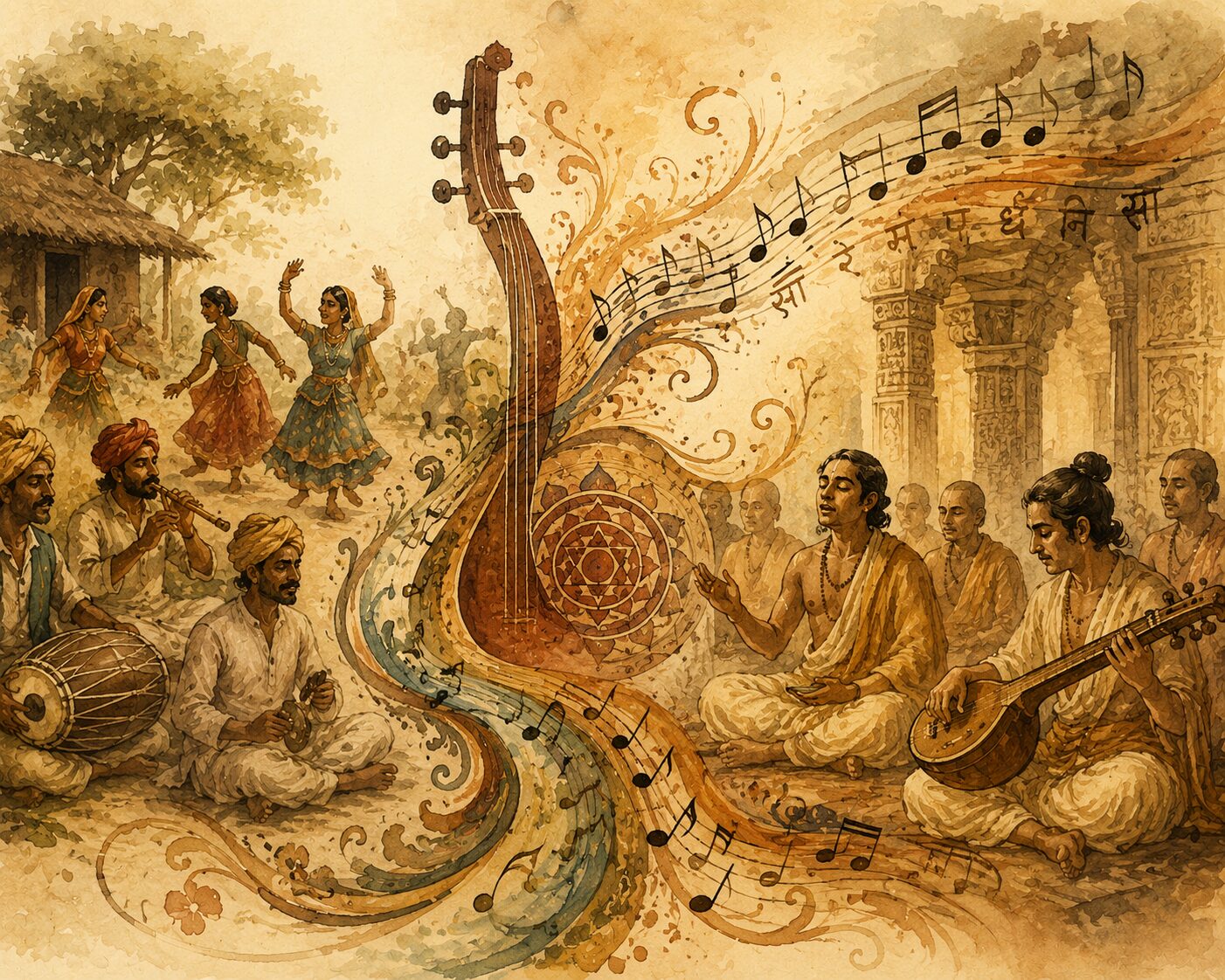
This was a historic moment in the evolution of Indian music. What followed was a long period of amalgamation (fusion) of Vedic music with the folk melodies that were already in vogue here. The incorporation of folk melodies from the various pre-Aryan tribes led to a widening of the musical imagination of the Aryans and to the formation of a new type of music which was known in the beginning as Marga. Later, this name was equated with Gandharva. Marga, which only meant ‘that has been sought’, marked the origin of classical music.
How Sama Veda shaped musical aesthetics
Admittedly, an aura of spirituality is ascribed to all branches of knowledge of Indian origin, and music is no exception. So, when Brahma, who extracted music from Sama Veda, is mistaken for the Creator of the universe, we can see the tendency to introduce an ethereal tinge to music. No one cares to point out that Brahman was none other than the director of the Aryan sacrifice, who instructed other priests in the conduct of the ritual and was therefore well-versed in both ritualistic practices and Saman music. There were not one but many mortal Brahmans who could be credited with the stupendous task of creating the art music of the country which we are really proud of.
It may be remembered that the mode of singing Sama Veda was lost irrecoverably to us many centuries ago. What is extant today is only its chantings. The non-uniformity in the style of chanting across the country may be imputed to the endless process of metamorphosis over the centuries. But still, one has to remember that the music that originated during the period of Sama Veda contributed immensely to the system of Indian classical music that attained a well-knit scientific structure over the centuries.
Indian music owes the evolution of a musical scale to Sama Veda, since a full-fledged scale emerged for the first time in the history of mankind during that period. It was then a natural corollary that the technique of murchana also followed, as this entailed the use of each note in the scale as tonic.
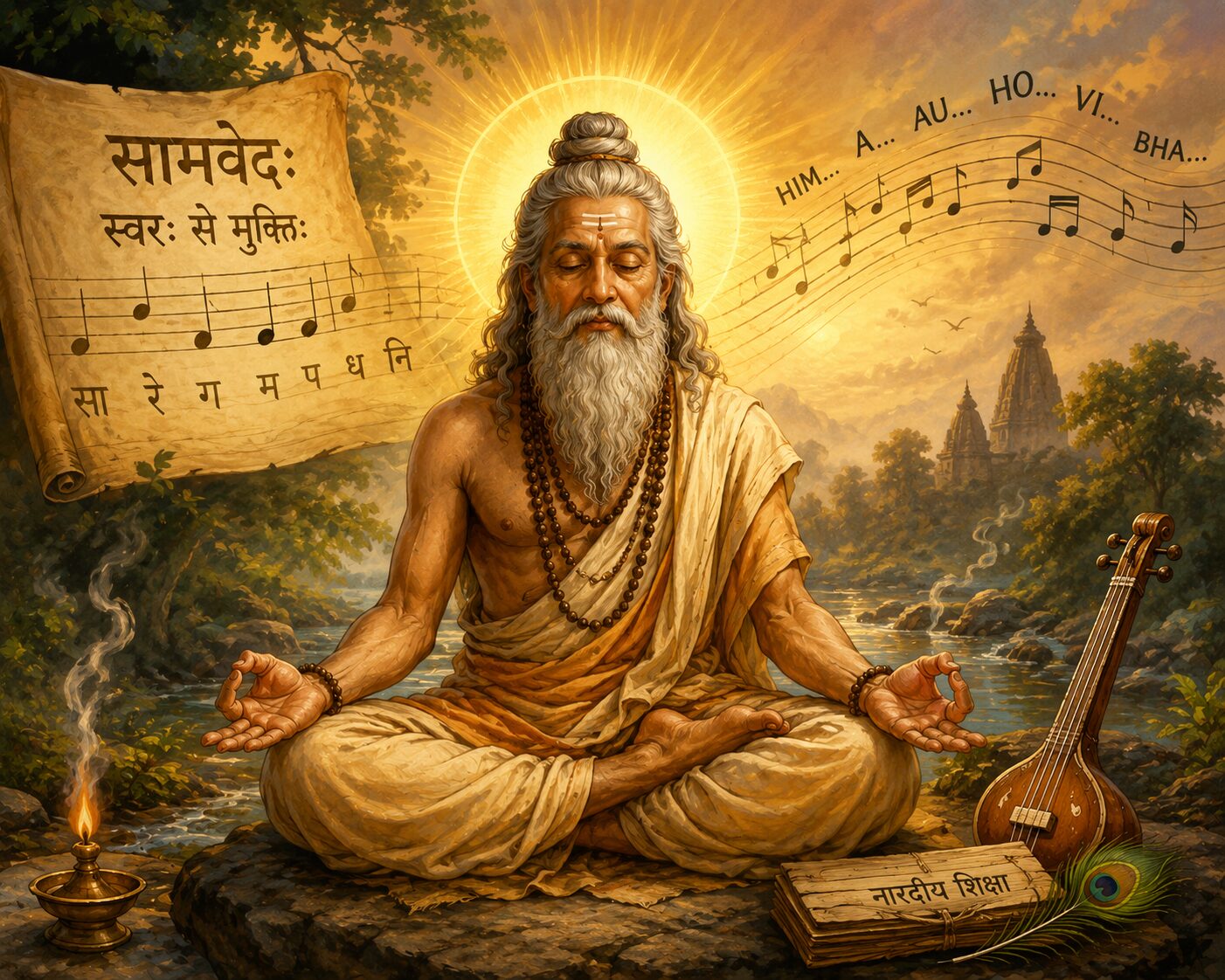
Perhaps the immortal contribution was in the development of musical aesthetics. In Saman singing, music was given more importance than the verses. This is discernible even in the chanting of present times, when Stobhas like Him, A, Au, Ho, Vi, Bha, which convey no particular meaning, are widely used. The sole purpose is the enhancement of the melody. Admittedly, such sounds are not uncommon in the alapana of a raga even today.
Also, the splitting, twisting and dragging of verses have been approved by scholars. According to Matanga, the author of Brihaddesi, “Music should prevail in the singing of the Saman as against its meaning, in its recitation”. Needless to mention the relevance of this practice to Indian classical music of today, especially the Hindustani system, which hardly attaches any importance to the Sahithya. It is the raga or the melody that is highlighted in a recital.
Music beyond meaning
There is a very interesting anecdote in this connection. One of the outstanding Hindustani musicians used the postal address of his residence as Sahithya during a recital, in the midst of which he had forgotten the verses!
Chandogya Upanishad says proper singing of Samans leads one to Moksha. This is an idea that formed the philosophical underpinning of the belief that mukthi can be attained through music. Small wonder, then, that music is still regarded as a form of worship in our country. Needless to mention that Kirtana is one among the nava-vidha bhakti marga.
It may appear strange that in different cultures across the world, the word Sama appears related to liturgical music. The word literally means liturgical music in Hebrew, Arabic and Latin. Even English is not an exception, in which it is known as ‘psalm’, but pronounced as ‘sam’.
The umbilical relationship which music enjoys with Sama Veda is therefore very strong.