

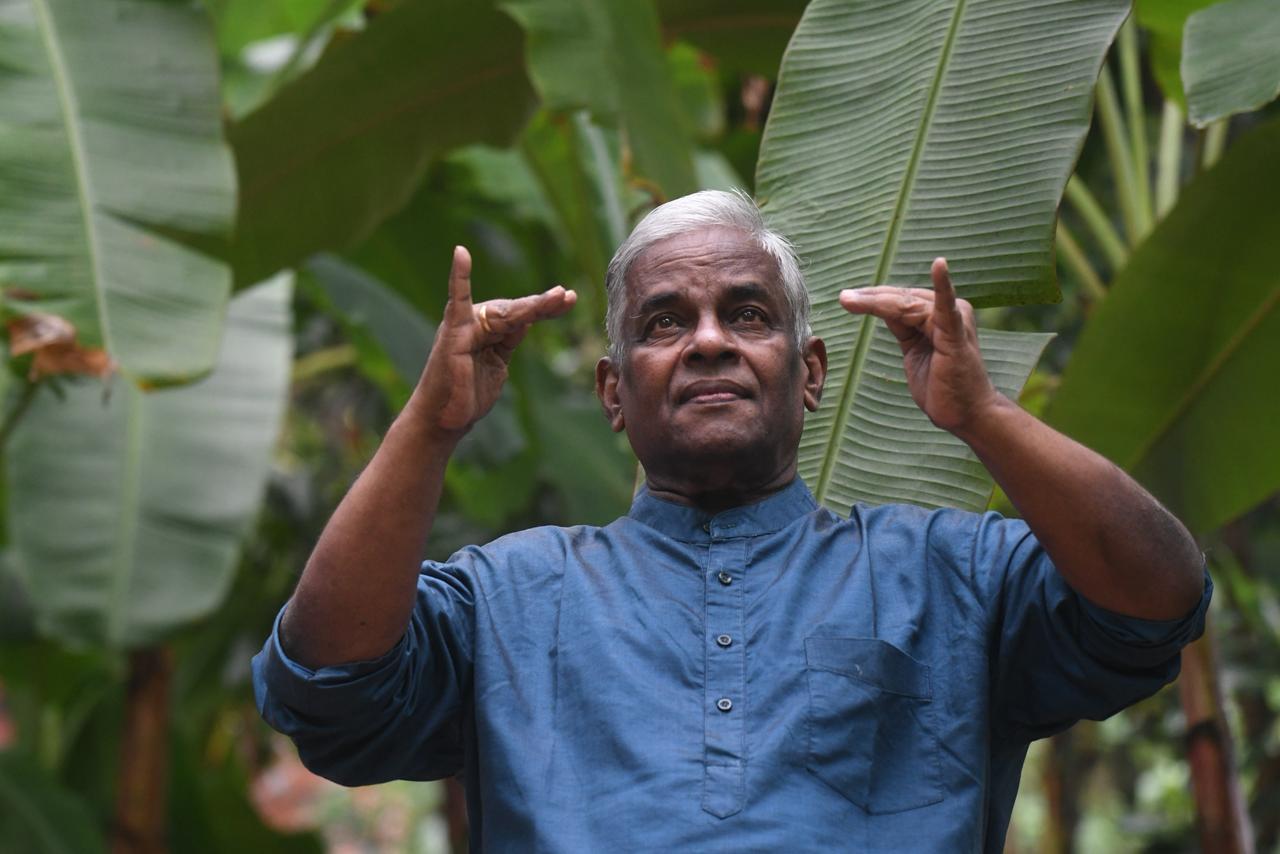
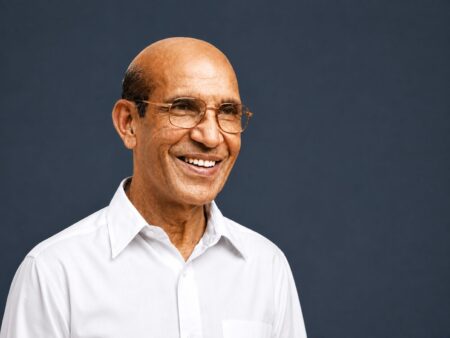
Spanning nearly seven decades, G Venu’s work as a performer, teacher and institution-builder has played a key role in the continuance of Kutiyattam.
The Kerala Sangeetha Nataka Akademi last week announced its prestigious Fellowship to Kutiyattam guru G Venu, recognising nearly seven decades devoted to the practice of Kutiyattam and to expanding its reach internationally. The honour comes after a gap of 36 years since the last fellowship awarded in Kutiyattam; the previous recipient was Ammannur Madhava Chakyar in 2000, Venu’s guru. Over these decades, Venu has worked across multiple roles—performer, teacher, organiser, researcher and writer—each enriching the other.
The recognition also comes soon after the completion of 50 years of Natanakairali, the institution Venu founded in July 1975. Conceived as a space where performance, training and research could exist together, Natanakairali has evolved into a significant centre for theatre practice in Kerala. Alongside Kutiyattam, the institution has played a sustained role in reviving and preserving Pavakathakali—the Kathakali tradition performed with puppets—and in the renewed study and practice of Tholppava Koothu.
Through workshops, long-term interactions and collaborative processes, it has also been closely involved in the revitalisation of folk and ritual forms such as Kakkarissi Natakam, Padayani and Mudiyettu. Over the years, innumerable artistes have passed through Irinjalakuda, carrying forward insights and skills shaped by these encounters.
Kalidasa on Kutiyattam stage
Across these seven decades, Venu has occupied a range of positions within Sanskrit theatre, often simultaneously. His work has moved with ease between practice and pedagogy, between stage and archive, without privileging one over the other. Among his landmark interventions was the staging of Kalidasa’s Abhijnana Shakuntalam in Kutiyattam—an ambitious undertaking, given that Kutiyattam had rarely engaged with Kalidasa’s plays.
Conceived as an eleven-hour production, it was performed across major cities in India and internationally, expanding both the repertoire and the performative possibilities of Kutiyattam. His latest production, Mricchakatikam (The Little Clay Cart), directed last year, brings King Sudraka’s 5th-century play into the Kutiyattam stage and has since been performed in several cities across India. This capacity to sustain multiple responsibilities—with consistency rather than assertion—has shaped both Venu’s artistic trajectory and the broader contemporary understanding of Kutiyattam.
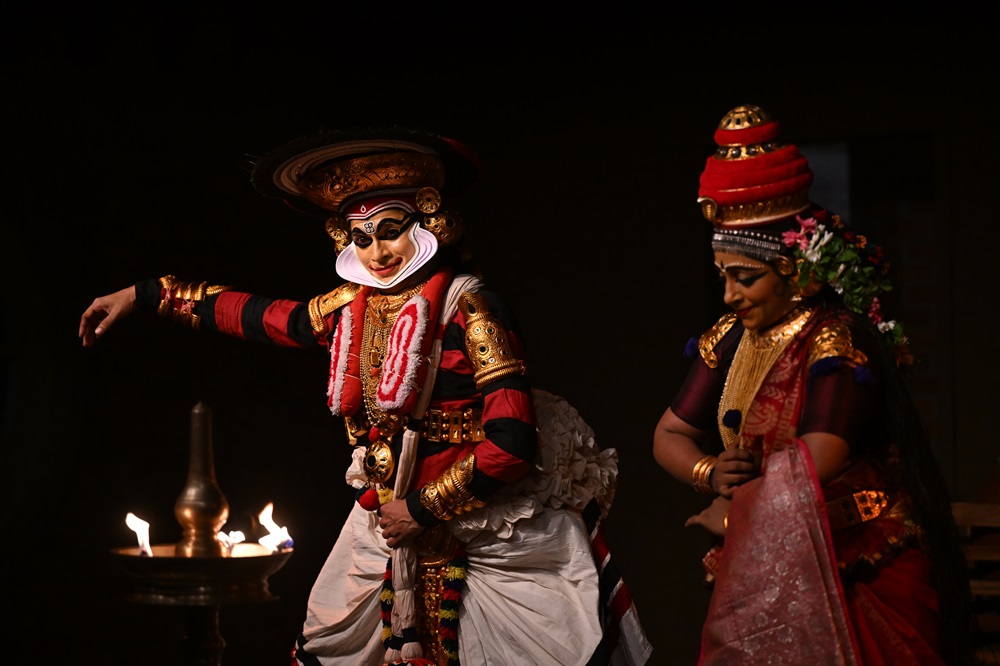
Trained initially in Kathakali from the age of 11, Venu studied under stalwarts such as Guru Gopinath and Chengannur Raman Pillai. Even in his early years, his curiosity extended beyond virtuosity. He was drawn instead to the inner mechanics of performance—the logic of mudras, the architecture of abhinaya, and the subtle processes through which emotion is generated and transformed on stage. This analytical temperament would later define both his pedagogy and his scholarship.
A decisive turn came during his tenure as a teacher at the School of Drama, Calicut University. Witnessing a Kutiyattam performance by Ammannur Madhava Chakyar at the Vadakkunnathan Temple Koothambalam proved transformative. Venu encountered, with startling clarity, the vast theatrical possibilities embedded within Sanskrit drama. At the age of 37, he resigned from his academic post, moved to Irinjalakuda, and sought admission to the Ammannur Kalari—becoming its first non-Chakyar disciple.
This was more than a personal apprenticeship. Venu’s entry into a lineage historically restricted by caste marked a crucial moment in the secular reimagining of Kutiyattam. Under Ammannur Madhava Chakyar, he trained with uncompromising discipline, while also assuming the roles of caretaker, organiser and chronicler of his guru’s work. The relationship shaped him into one of the foremost contemporary authorities on the form and led, in 1982, to the founding of the Ammannur Chachu Chakyar Smaraka Gurukulam.
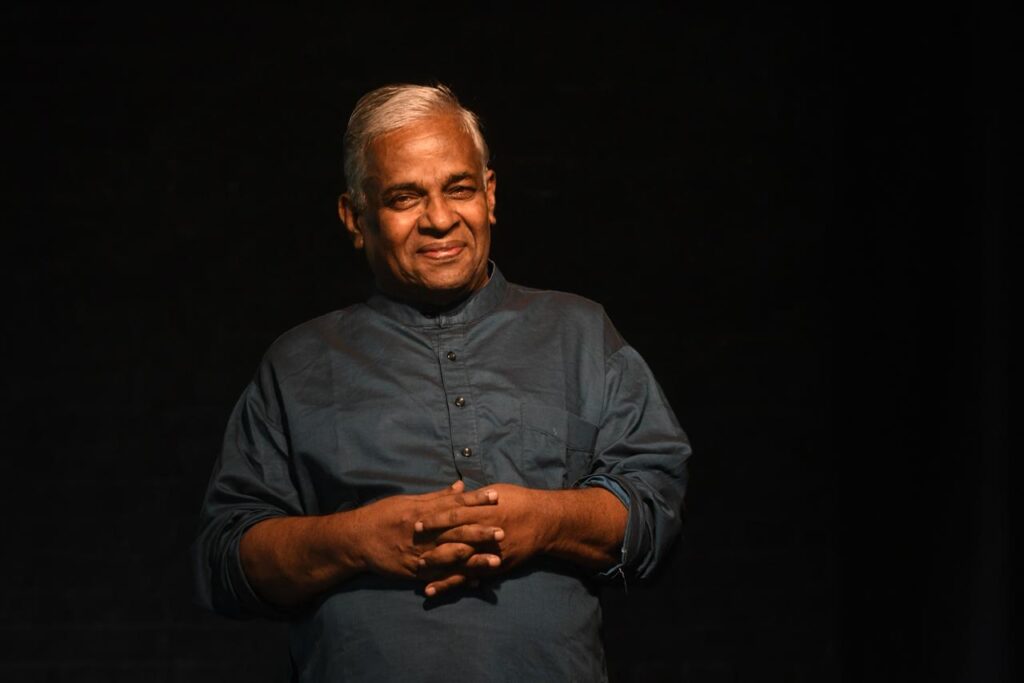
Natanakairali emerged from what Venu often describes as an “insatiable urge”—to create a space where performance, pedagogy and research could coexist without hierarchy. Over five decades, it has become a home for artistes and scholars from across India and the world. Many practitioners across disciplines trace their artistic grounding to long residencies and workshops at Irinjalakuda.
A unique actor training methodology
Among Venu’s most influential contributions is Navarasa Sadhana, a rigorous actor-training methodology born from nearly seven decades of enquiry into the nature of rasa. Drawing inspiration from early twentieth-century experiments at the Kodungallur Palace Kalari, as well as from close observation of Ammannur Madhava Chakyar’s practice, Venu identified breath as the central catalyst of emotional experience. These explorations led him to the concept of Swara Vayu—the “voice of breath”—a technique rooted in the pedagogic traditions of the Kodungallur Kalari.
Navarasa Sadhana evolved through a series of intensive workshops focused on Swara Vayu, netra (eye movement) and hastha (hand gestures). Masters of Kutiyattam and Kathakali worked alongside classical dancers, tantric practitioners and ritual performers from traditions such as Theyyam and Mudiyettu. The process was deliberately interdisciplinary, privileging lived experience over stylistic conformity.
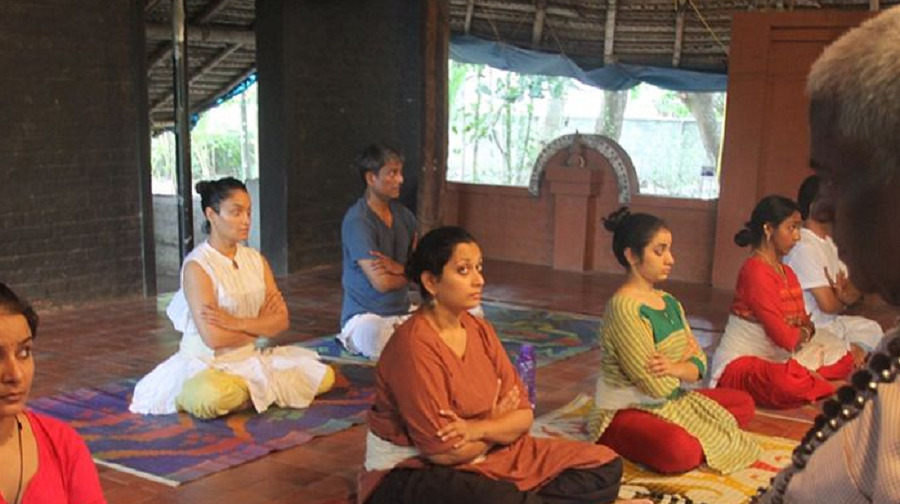
Engaging deeply with the Natyasastra, Venu returned to the foundational principle of rasa formation—vibhavanubhava vyabhichari samyogath rasa nishpatti. While determinants and consequents had long dominated performance practice, he felt that the vyabhichari bhavas—the transient emotional states—remained insufficiently explored. His methodology addresses this gap by grounding training in sensory and emotional immersion rather than externalised imitation.
Students are introduced to specific vibhavas—loss, insult, separation, or the knowledge of the ultimate—and encouraged to internalise them through intense concentration and free exploration. What emerges is not performance, but experience. Transformation, Venu insists, must precede representation: from individual to actor, from actor to character. His own role remains minimal, offering only gentle interventions and stories drawn from the lives of earlier masters.
Between stage, pedagogy and archive
Parallel to his work in training has been Venu’s lifelong commitment to documentation. His interest in codifying mudras began during his Kathakali years, when he recognised the urgency of preserving this complex sign language. This culminated in Mudra (2023), a landmark publication cataloguing 1,752 hand gestures across Kathakali, Mohiniyattam and Kutiyattam —one of the most extensive such compilations in the world. The work introduces a systematic alphabet and notation method for hasta mudras, offering performers and scholars an invaluable analytical tool.
Venu’s writings further reflect this dual commitment to clarity and depth. Into the World of Kutiyattam, co-authored with Ammannur Madhava Chakyar, and Kathakali, Kutiyattam and Other Performing Arts stand out for their lucid engagement with complex traditions. His collaborative works with Nirmala Panicker on Mohiniyattam extend this ethos of careful documentation and contextual understanding.
The Akademi Fellowship, then, recognises not merely a lifetime of achievement, but a mode of cultural stewardship—one that has ensured Kutiyattam’s continuity without fossilisation.

1 Comment
Excellent