
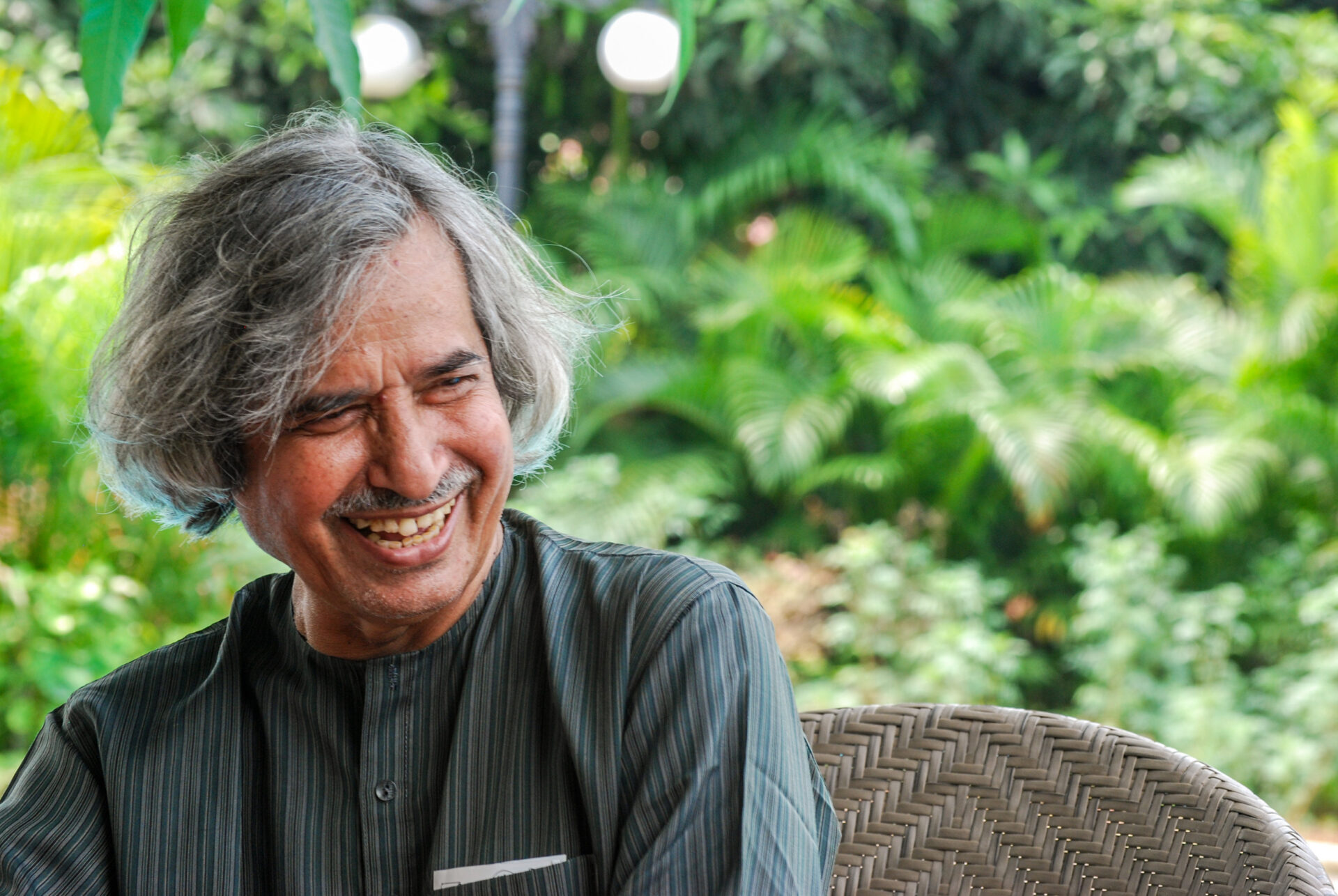
Jogen Chowdhury, who passed away on October 25, leaves behind an influential legacy in Indian modern art. Over a career spanning several decades, he challenged established notions of figuration and expanded the possibilities of artistic expression. This tribute revisits his artistic journey and the distinctive vision that secured his place among India’s foremost modern artists.
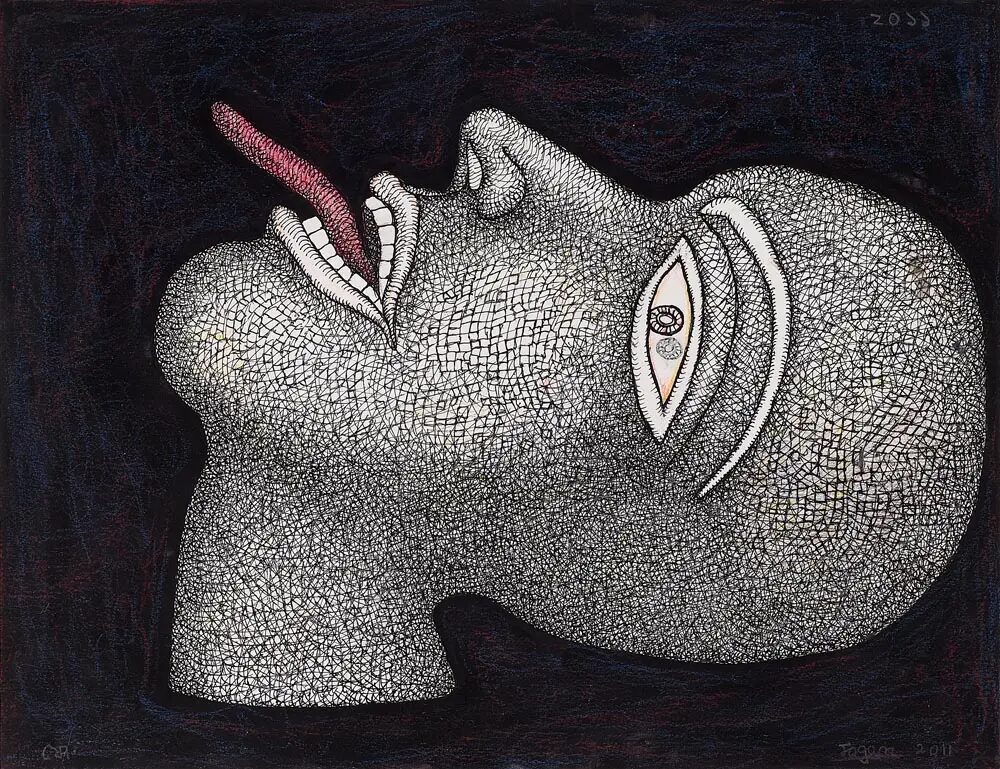
Jogen Chowdhury developed a style of painting that was distinctly his own. He used fine lines, repeated strokes and unusual shapes to give his figures a strong physical presence and convey their emotions. Art critic Keshav Malik observed that, despite the strong emphasis on lines, Chowdhury’s paintings retained a sense of depth. His careful use of lines, brushstrokes and space gave his figures a sense of fullness, allowing each to stand out without dominating the composition.
Many of the influences behind this style came from his childhood in rural Bengal. Chowdhury often recalled working with clay and observing the trees, creepers, ponds and fish around him. Watching artisans make Durga idols, particularly the ritual of chokshudaan, when the goddess’s eyes are painted, left a lasting impression on him. The wide, staring eyes that frequently appear in his paintings reflect these early memories, giving his figures a striking presence and an occasional sense of unease
Bengal’s traditional art forms also played an important role in shaping Chowdhury’s work. He drew inspiration from the terracotta sculptures of Birbhum and Bankura, the unusual perspectives of patachitra and the satire found in Kalighat paintings. Rather than copying these styles, he adapted elements of them to develop an approach of his own.
Chowdhury also wanted to move beyond the realistic style of academic painting. While he explored abstraction, he continued to work with recognisable human figures. This gave his paintings a distinctive quality, bringing together realistic forms and abstract elements. Through his use of lines, shapes and muted colours, he gave the human figure a strong sense of expression and presence.
Social commentary and the human figure
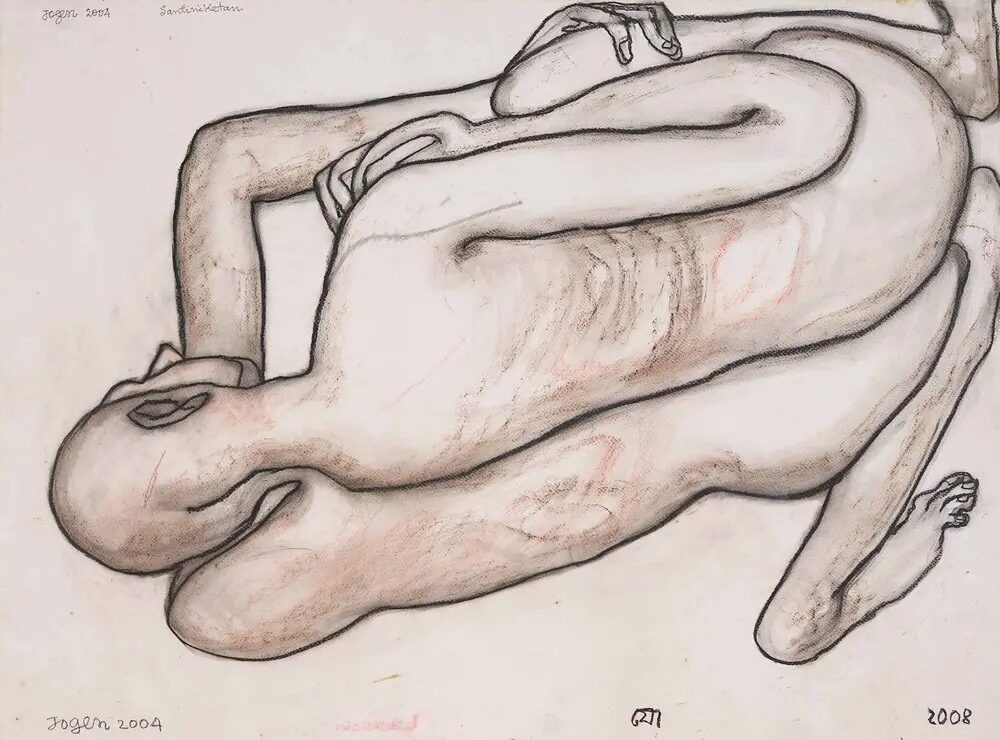
For Jogen Chowdhury, the distortion of the human figure was never merely a formal exercise. The slack bodies, twisted limbs and disproportionate features in his paintings arose partly from the poverty, unemployment and dislocation he witnessed in the years following Partition. These bodies, soft and yielding as clay, bear the imprint of their circumstances. As Chowdhury observed, their distortions articulate the condition of society, each figure giving it a particular form.
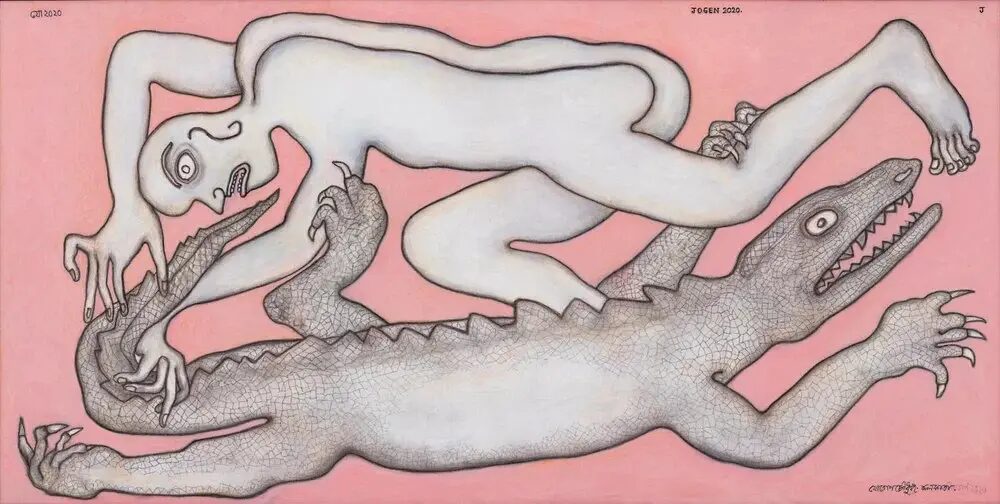
Chowdhury’s engagement with the human figure also carries a political charge, locating violence and oppression in the body itself. Works such as Wounded (2004) and Untitled – II (2007) reflect his sustained interest in bodily vulnerability, distortion and the uneasy relationship between human beings and forces of menace. Rather than illustrating specific political events, such imagery evokes broader structures of violence and subjugation, in which the body becomes a register of social tensions and unequal power.
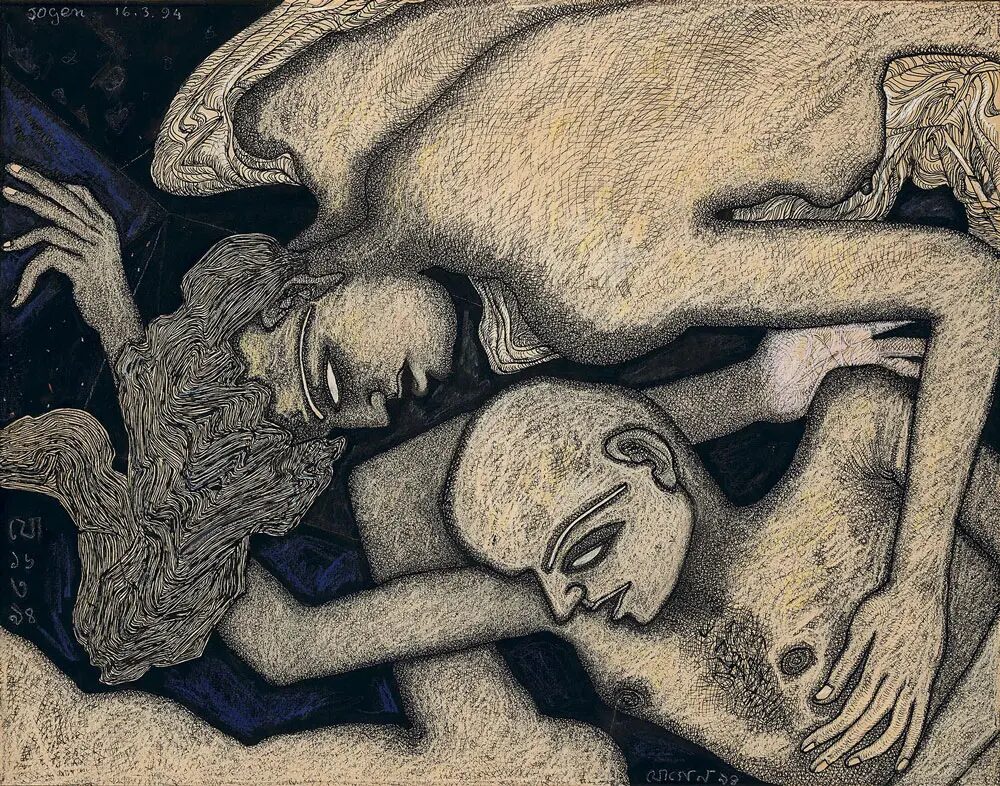
Yet Chowdhury’s figures inhabit a world beyond political allegory. His men, often flabby, ungainly, and seemingly helpless, find themselves beside women whose sensuality and force of presence command the composition. Their encounters are charged with desire, awkwardness, and ambiguity. Here, the body becomes an instrument for examining the vagaries of human behaviour, where attraction and abasement, pleasure and unease, remain inseparable. Memory, too, permeates his imagery. Snakes, strange creatures, village ponds, lotuses and the wide eyes of Durga draw upon his childhood in rural Bengal. These images carry the residue of lived experience, yet retain an element of mystery. Moving between social observation and the inexplicable, Chowdhury’s art apprehends the human condition in all its frailty, sensuality and contradiction.
Contribution to modern Indian art
Chowdhury’s contribution to modern Indian art lay in his refusal to treat figuration as a fixed or exhausted language. He found in the human figure a means of formal reinvention, importing the possibilities of abstraction into recognisable bodies without surrendering their particularity. Equally significant was his engagement with indigenous visual traditions—not as forms to be replicated, but as resources to be reinterpreted. In doing so, Chowdhury challenged the divide between a modernism oriented towards international movements and an art rooted in the specificities of Indian life.
This engagement with tradition also informed the distinctive erotic charge of his work. Unlike idealised representations of the body, Chowdhury’s sensuality emerged through physical irregularity: slack flesh, exaggerated proportions, creased skin and the awkward proximity of figures caught in intimate encounters. Desire, in these works, is neither ornamental nor simply celebratory. It is entangled with discomfort, power and the absurdities of human behaviour; attraction can shade into unease, and pleasure into abasement. This sensuality is distinctly untheatrical, grounded in the familiar gestures and imperfect bodies of lived experience rather than in the spectacle of idealised beauty. By allowing sensuality to coexist with distortion, humour and vulnerability, Chowdhury made the body a site of both formal experimentation and social observation. His work demonstrated that modern Indian figuration could engage with desire and the complexities of human relationships without relinquishing its cultural specificity.
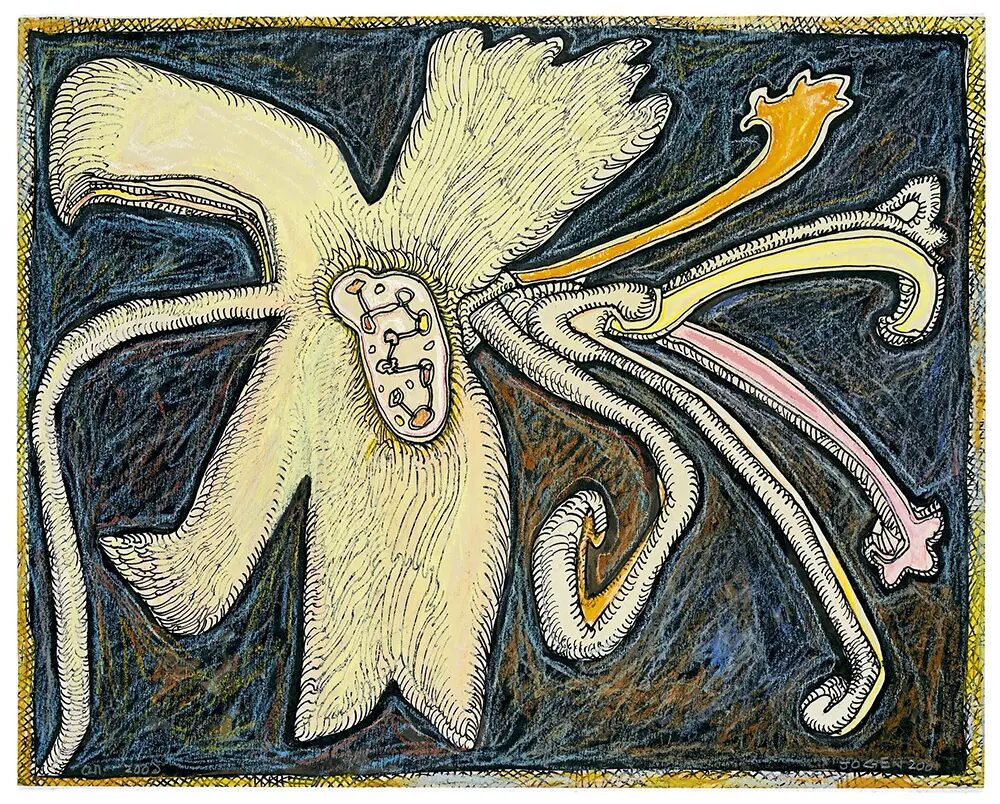
His influence on subsequent generations lies in this expanded understanding of what an Indian artistic idiom could be. His work extended beyond distorted figuration, often bordering on the surreal. In Untitled (Reminiscences of a Dream Series) (1969), fish-like forms and a monumental, flower-like shape emerge against a dark, dreamlike ground, unsettling the boundaries between the familiar and the inexplicable. Such imagery reveals how Chowdhury drew upon the visual memory of Bengal while pursuing concerns central to modernism: abstraction, the subconscious and the instability of representation.
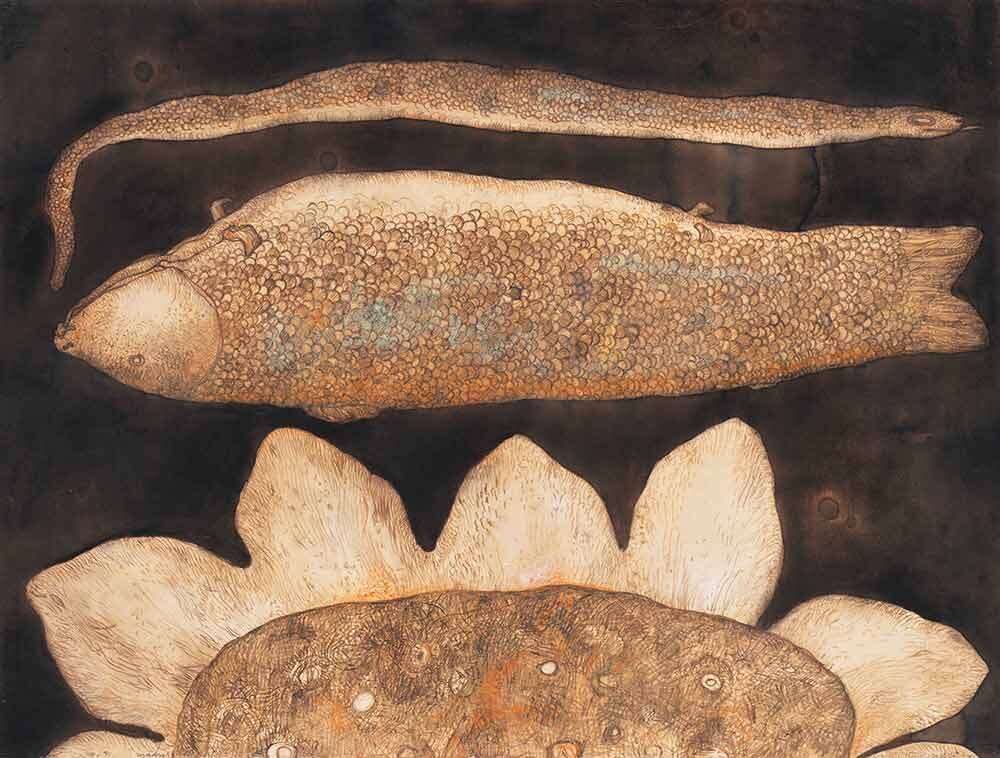
Jogen Chowdhury leaves behind a body of work in which clarity of line coexists with an elusive sense of mystery. His compositions possess a palpable fullness, their forms emerging through painstaking cross-hatching, yet retaining a certain strangeness that resists complete explanation. Individual images hold their own against generous expanses of space, remaining distinct yet harmonious within the whole. With his passing away, Indian art loses an artist who never ceased to evolve, whose practice moved between the real and the imagined without entirely belonging to either. His images endure not because they offer definitive answers, but because they continue to inhabit the mind, gathering new meanings with each encounter.