
Prince Rama Varma’s recent concert at Tripunithura combined popular and rare kritis with humour and lively audience interaction.
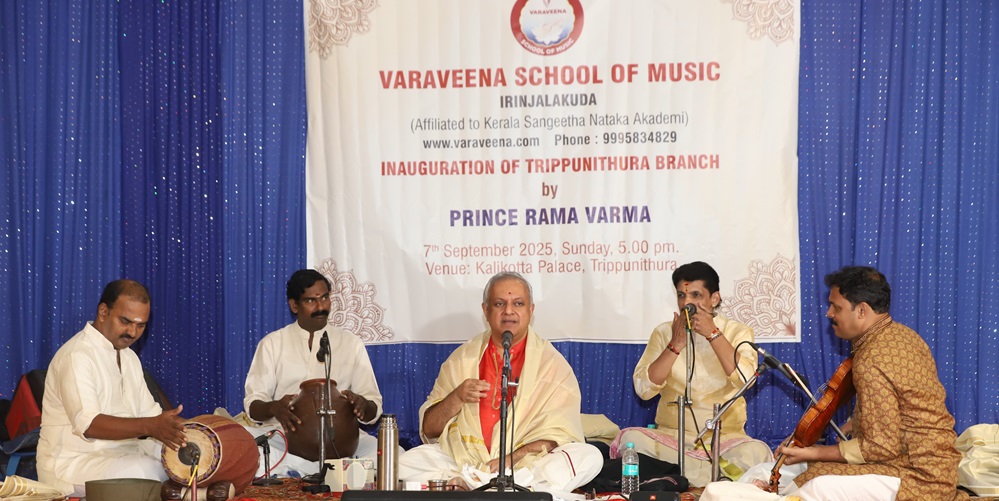
Concerts are often thought of as one-way journeys—musicians performing, audiences listening. But at Kalikotta Palace in Tripunithura, Prince Rama Varma reminded us that music can be a dialogue. His recent vocal recital was not just a presentation of Carnatic tradition but an interactive, enlightening, and thoroughly enjoyable evening that spoke to connoisseurs and casual listeners alike. With a balanced repertoire that ranged from the familiar to the rare, the concert was a celebration of both creativity and spontaneity.
The opening invocation was a shloka on Lord Poornathrayeesa, composed by Aswathi Thirunal Srimathi Thampuran. From there, the performance moved seamlessly into the much-loved Mohanam varnam “Ninnukori,” a staple of the music classroom but rarely heard on the concert platform. Rama Varma not only sang it in three speeds, including a playful tisra variation, but also offered the backstory of its composer Poochi Srinivasa Iyengar, whose nickname, meaning “insect” in Tamil, came from his swara flights reminiscent of a buzzing insect. Such anecdotes, peppered with humour, enlivened the atmosphere and made even complex details accessible.
Setting the tone
Popular Swathi Thirunal composition, Deva Deva Kalayami in Mayamalavagowla, followed. The extended swaraprasthara—nearly fifteen minutes long—stood out for its expansive sweep across octaves, descending deep into the mandra sthayi before soaring upwards again. This blend of intellectual rigour and aesthetic ease characterised much of the evening.
The selection of compositions displayed both variety and depth. From Tyagaraja’s rarely-heard Kripaalavaala Kalaadhara Sekhara in the unusual raga Nadavarangini, to M D Ramanathan’s Neevane Daivamu in Yadukula Kambhoji, each piece was preceded by an explanation that contextualised its meaning. A Purandaradasa kriti, Hodi Nagari Mele Kaiyya in Anandabhairavi, carried echoes of his guru Dr. M. Balamuralikrishna’s renditions, once again bridging memory with live performance.
Meaningful narratives
The main item of the evening was a majestic exploration of Amruthavarshini. Rama Varma’s alapana unfolded with clarity and restraint, evolving from delicate phrases to vibrant cascades. The kriti, Ahaha Naivajaane from Swathi Thirunal’s opera Kuchelopakhyanam, was highlighted for its lyrical beauty and swarakshara precision, reminiscent of his guru’s style. Trivandrum S.R. Vinu on the violin matched him at every turn, their rapport creating moments of exquisite musical dialogue.
The concert wound down with the soothing strains of Seetha Kalyana Vaibhogame in Neelambari, followed by Rama Rama Yena Raja of Prayaga Rangadasa, in Sindhubhairavi, and concluded with a lively Kundalavarali tillana.
The percussion ensemble—Njangil Arul (mridangam), Trivandrum R. Rajesh (ghatam), and Payyannur Govindaprasad (morsing)—added depth and sparkle, their synergy enhancing the concert’s dynamism. The swaraprasthara, where each instrument took turns responding to the vocalist, offered a fresh and delightful experience for the audience
The concert was organised by the Irinjalakuda-based Varaveena School of Music to mark the opening of their new branch in Tripunithura.