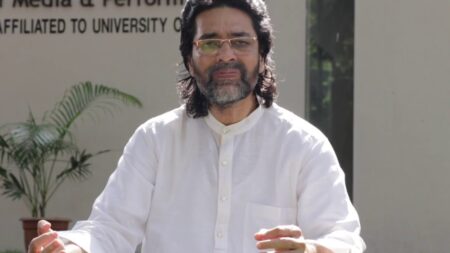


Akash Sharma is a sound researcher, conservationist, creative technologist and the founder of SOUND.CODES whose work explores the intersection of sound, technology, and heritage. This conversation draws from his lecture Decoding Sound: What You Hear Is Not Always True, presented at the Kochi-Muziris Biennale.
We often think of hearing as something passive—something that just happens to us. But your work suggests listening is shaped by memory, emotion, and context. You’ve spoken about our “immediate history” acting as a filter for how we hear sound. Could you explain this idea?
We never hear with the ears alone. We hear with our experience. If you wake up after an argument, or after a stressful morning, or even after something as small as a bad breakfast, your brain is already tuned to a particular emotional frequency. When you encounter ambiguous sounds — what we call “phantom words” — fills the gaps using whatever emotional material is most available.
But this does not stop with the present moment. It extends to the previous day, the previous week, even to collective social stress. During times of uncertainty — economic pressure, social unrest, environmental anxiety — people interpret sound differently. The brain is constantly searching for patterns, and it builds those patterns from the closest available material: worry, desire, fear, or hope. In that sense, listening becomes a psychological mirror.
Many people are surprised when they hear their own recorded voice. It often feels unfamiliar, even disturbing. What is the reason for this?
When you speak, you are not hearing a single sound channel. You are hearing a complex internal and external mix. Inside your body, sound travels through bone conduction. Your chest, ribcage, skull — all of them vibrate. Classical vocal traditions, such as Dhrupad singing, consciously work with this bodily resonance. That sound never leaves your body.
At the same time, your voice travels outward into the room. It reflects off walls, floors, furniture, and surfaces. This reflection creates reverberation — the spatial character of sound. Your brain merges both experiences into one perception.
A microphone, however, can only capture the external sound. It cannot record the vibrations moving through your bones. When you listen to a recording, half of your sonic identity is missing. That absence creates the feeling of estrangement.
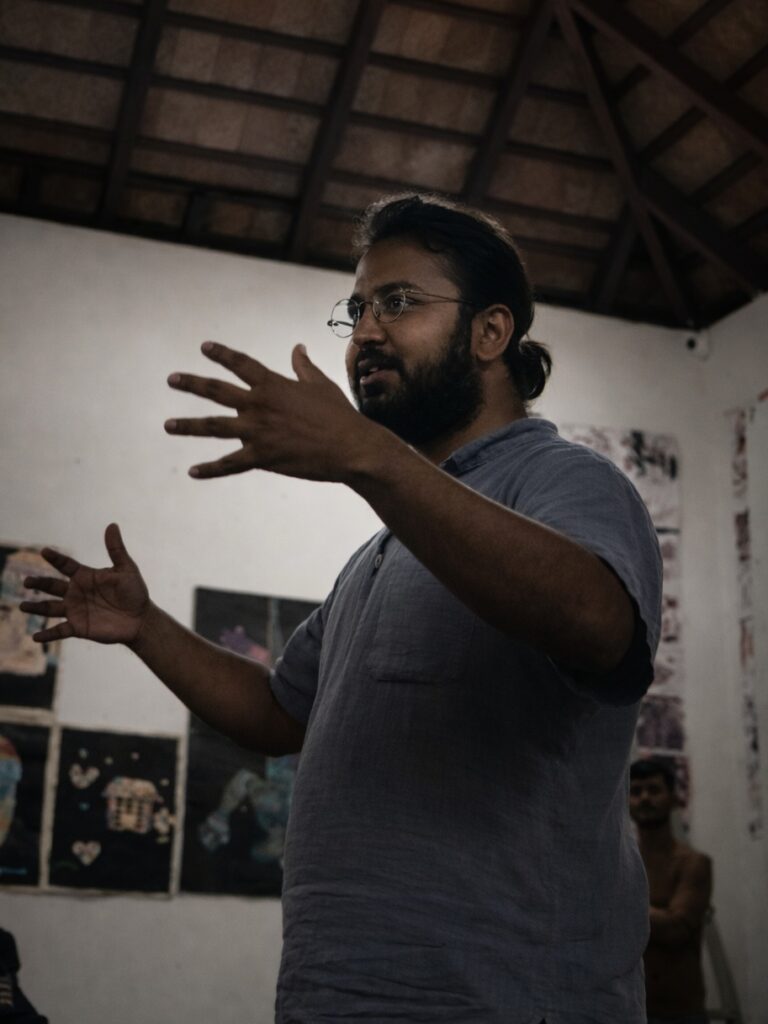
Cinemas and enclosed spaces often leave people mentally exhausted. Is this a failure of sound design or a bodily reaction?
It can be both. Sometimes it is physical — poor ventilation, lack of oxygen, or sensory overload. Acoustically, certain spaces are badly designed. Too much reflection overwhelms the brain. Too little reflection creates unnatural silence.
But often the exhaustion comes from narrative conflict. When sound does not emotionally match the image — when a scene feels artificial, forced, or aesthetically dishonest — the brain has to work harder to resolve the contradiction. Sound is not only technical; it is psychological storytelling.
Many musical traditions define harmony and dissonance very strictly. Are these categories rooted in physics or cultural training?
Mostly culture. Physics only tells us frequency relationships. Meaning is assigned by society. In Western classical traditions, certain intervals are labelled “correct” while others are considered “wrong.” Indian classical systems also follow structured emotional frameworks known as rasa.
Jazz offers a good example of cultural reprogramming. To an untrained listener, jazz can sound chaotic. But once you learn its grammar, the so-called dissonance becomes expressive. It is similar to food preferences. Some people dislike bitter flavours or strong spices. That does not make them objectively unpleasant — only unfamiliar.
You mentioned Indonesian Gamelan traditions, where instruments are allowed to drift out of tune over decades. What does this tell us about alternative sound philosophies?
It shows that decay can be sacred. In some Gamelan court traditions, musicians tune their instruments once and never retune them again. Over decades, both musicians and instruments age together. Their bodies change. The metal changes. The tuning slowly drifts.
From a scientific perspective, this is measurable acoustic decay. But culturally, it becomes spiritual continuity. Sound is not preserved as perfection — it is preserved as living history.
Could you explain the technical ideas of rhythm and spatial sound in simple terms?
At its simplest, every sound has a life cycle. Musicians often describe this through four stages—how a sound begins, how it settles, how long it stays, and how it finally fades away. A sharp drum strike, for instance, starts instantly, swells, holds its presence for a brief moment, and then dissolves into silence.
But sound does not exist in isolation. The moment it is released into a room, it begins to converse with space. A clap in a concert hall lingers, leaving behind an echo that gently trails off; in a narrow corridor it rebounds sharply; in an open courtyard it disperses almost at once. These lingering traces—what acousticians call decay—are shaped by walls, ceilings, curves and distances.
In this sense, rhythm is not only a matter of time, but also of place. Every sound carries the imprint of the space it inhabits, reminding us that music is always as much about architecture as it is about listening.
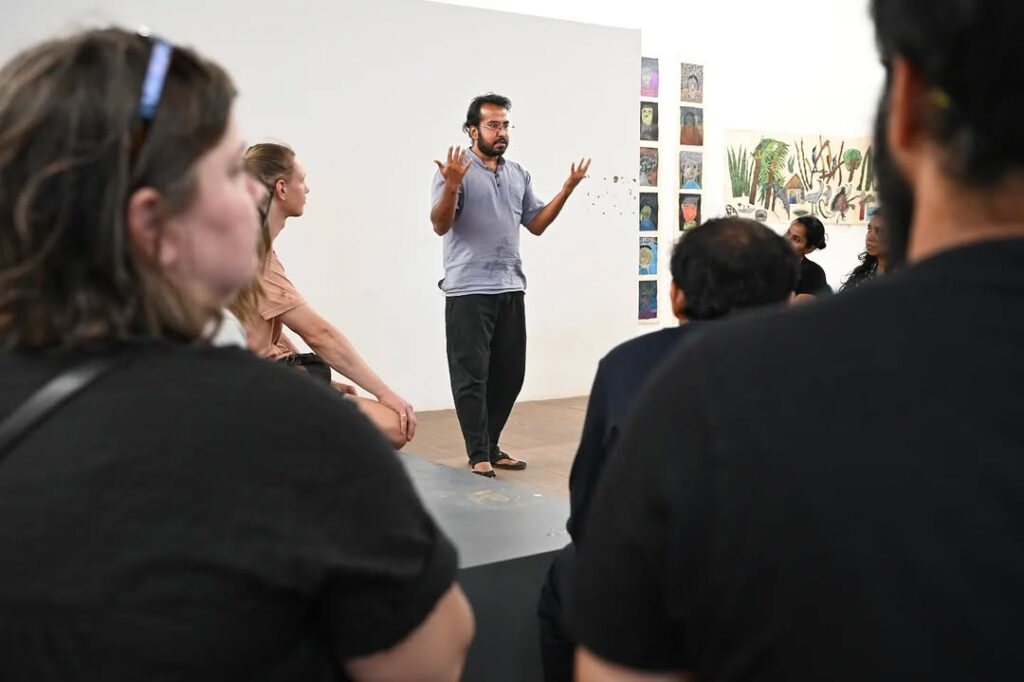
Your personal journey bridges engineering and art. How did you move from death metal to sound programming?
I studied computer science, but I was always a musician. Around the early 2000s, computers became powerful enough for real-time sound manipulation. I began writing algorithms that didn’t just play audio files but generated sound behaviour.
I wanted sound to be mathematical movement — rising, falling, evolving. Over time, these experiments became open-source tools. People started using them. Eventually, this became professional work. It was a natural meeting point between creative instinct and computational logic.
Is there such a thing as noise, or is everything potentially music?
Noise is simply sound without assigned meaning. In an anechoic chamber — a room designed to be perfectly silent — people hear their own heartbeat, blood flow, and nervous system. Silence becomes overwhelming.
On a quiet mountain at night, the absence of sound can feel louder than a city. Whether we call something noise or beauty depends entirely on perception. Sound becomes music the moment we recognise a pattern.
How can students and artists train their listening ability?
Record your environment. Walk in nature or through a market. Write down what you think you hear. Later, listen to the recording in silence and write again. Compare the lists. You will discover how much your mind invents, filters, and edits reality. That awareness is the foundation of critical listening.